
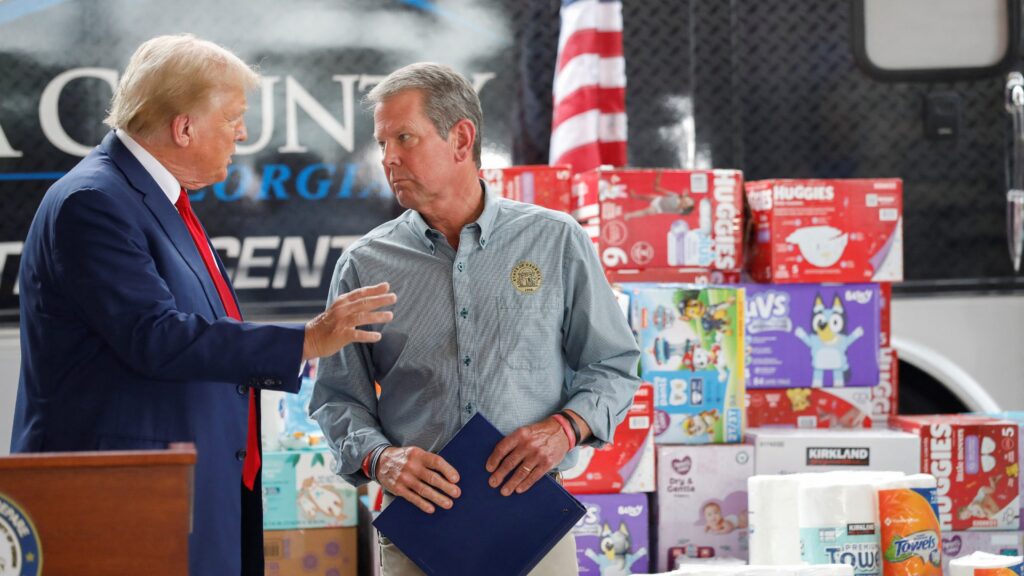
President Donald Trump’s iron grip on the Republican primary machinery faced its first real test in Georgia on June 16, as his preferred candidate squared off against the endorsement of the state’s popular governor. In the end, Trump’s man won, but the victory came with a clear message: the party’s internal wounds are far from healed.
Trump backed Representative Mike Collins in a critical U.S. Senate primary, going head-to-head with Georgia Governor Brian Kemp, who threw his considerable political weight behind Derek Dooley, a former college football coach and personal friend. The race was widely seen as a referendum on Trump’s influence heading into the 2026 midterms. Collins, an immigration hard-liner known for drafting the Laken Riley Act, sealed the nomination within an hour of polls closing. But the battle exposed lingering tensions in a state where Trump-backed candidates have lost multiple Senate races to Democrats.
The president’s success in Georgia was not mirrored everywhere. In Oklahoma, voters delivered a blunt verdict on economic policy, rejecting a ballot initiative that would have gradually raised the state’s minimum wage to $15 an hour by 2029. With more than 95% of votes counted, 56% of Sooner State voters opposed the increase, a stark contrast to national polls showing overwhelming bipartisan support for a higher federal minimum wage, which has remained stuck at $7.25 an hour for nearly two decades.
“Crazy” is how Oklahoma Democrat Erik Acosta described the current rate, echoing a sentiment shared by 86% of likely voters in a 2024 Data for Progress survey. Yet the defeat underscores the challenge progressives face in translating broad public sympathy into legislative victories, even in states where similar measures have passed in recent years.
Meanwhile, in Washington D.C., a different sort of political drama unfolded. Janeese Lewis George, a self-described democratic socialist on the City Council, appeared poised to become the nation’s capital’s next mayor, leading her moderate opponent, Kenyan McDuffie, 53% to 37% with 66% of results counted. Trump had explicitly warned against her election, threatening to “take back Washington” and run it on a federal basis. The threat, experts say, is not idle, given the federal government’s powers under the 1973 Home Rule Act.
The Georgia governor’s race also delivered a surprise. Despite Trump and Kemp both backing Lieutenant Governor Burt Jones, GOP voters chose Rick Jackson, a self-funded healthcare CEO who poured more than $100 million into his campaign. Jackson’s victory in an expensive runoff signals that money and outsider status can still outweigh establishment endorsements, even in a deeply conservative state.
In Alabama, the Trump effect was unmistakable. Representative Barry Moore, who trailed former Navy SEAL Jared Hudson by as much as 10 points in some polls, surged to victory after the president’s endorsement. In a deep red state, Moore’s primary win all but guarantees he will be Alabama’s next senator.
The June 16 elections offered a mixed verdict on Trump’s influence: powerful but not absolute, effective but not without cost. For Republicans, the path to the 2026 midterms remains clear but fraught with the same internal divisions that have haunted the party since 2020.



Comments are closed for this story.