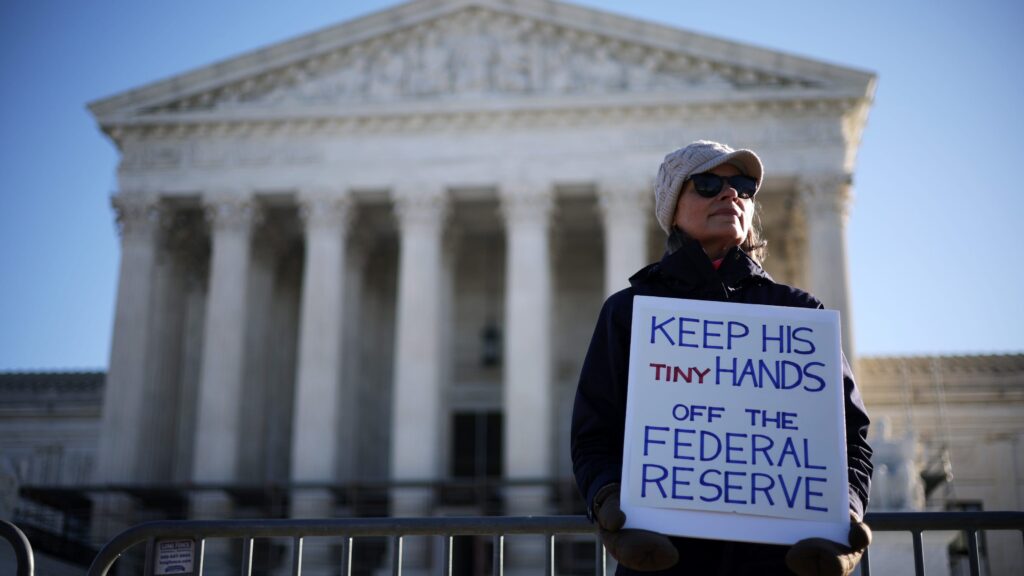
The Supreme Court handed President Donald Trump a stinging defeat on June 29, ruling he cannot remove Federal Reserve Governor Lisa Cook from her post. The decision marks a major check on presidential power over the nation’s central bank, following the court’s earlier rejection of Trump’s signature tariff policies.
The justices determined that Cook can remain on the Fed’s board of governors while she challenges the legality of her dismissal. This keeps the case alive in lower courts, where judges will debate whether Trump had sufficient cause to fire her. More broadly, the ruling reinforces decades-old congressional protections designed to shield the Fed from political pressure.
The Fed wields immense influence over the economy through its interest rate decisions. Lower rates can stimulate growth, boost employment, and reduce the cost of federal debt, while also making mortgages, auto loans, and credit card debt cheaper for consumers. Such moves could benefit Trump politically ahead of the midterm elections, as polls show widespread voter dissatisfaction with his economic stewardship. However, cutting rates too aggressively risks fueling persistent inflation and undermining long-term stability.
Cook has been a key voice for caution. “I currently believe that the right course of action is to hold rates steady,” she said in May at Stanford’s Institute for Economic Policy Research. Her approach has drawn Trump’s ire, with the president pushing for deeper and faster rate cuts.
Every living former Fed chair and a host of economists urged the Supreme Court to preserve the central bank’s independence. While presidents have historically pressured the Fed, Trump is the first to attempt removing a board member. The case unfolded amid revelations that the Justice Department investigated whether to bring criminal charges against then-Fed Chair Jerome Powell. Both Powell and Cook argued the allegations were fabricated to justify their firings after they resisted Trump’s demands.
Federal law permits presidents to remove a Fed board member only “for cause,” but the statute does not define the term or outline a removal process. Trump claimed in an August social media post that Cook had improperly declared more than one home as her primary residence to secure a favorable interest rate. Cook denied the charges and argued that allowing her removal without a fair hearing would gut the “for cause” protections and erode Fed independence.
“There’s no rational reason to go through all the trouble of creating this unique quasi-private entity… just to give it a removal restriction that is as toothless as the president imagines,” said Paul Clement, Cook’s attorney, during January oral arguments.
The administration countered that letting Cook stay on the board damaged the Fed’s reputation. “The American people should not have their interest rates determined by someone who was at best grossly negligent in obtaining favorable interest rates for herself,” Solicitor General John Sauer told the justices.
The court signaled early skepticism about Trump’s position when it agreed to hear arguments in October. In contrast, the justices had previously allowed Trump to temporarily remove leaders at other independent agencies. But in a May decision involving the Merit Systems Protection Board and the National Labor Relations Board, the court stressed that the Fed is fundamentally different. “The Federal Reserve is a uniquely structured, quasi-private entity that follows in the distinct historical tradition of the First and Second Banks of the United States,” the opinion read.
Trump has consistently tested the boundaries of executive authority, particularly over agencies designed to operate free from political interference. This ruling underscores that the Fed remains a special case.