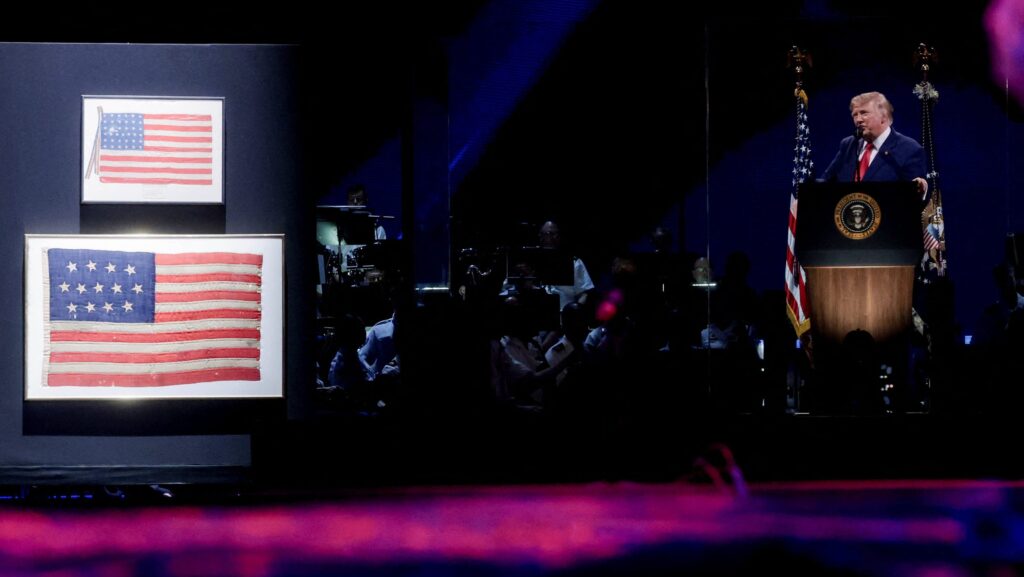
The midnight fireworks over the National Mall on July 4th were historic. So was the speech that preceded them, delivered by President Donald Trump after a storm that sent crowds scrambling for cover, only for them to return for what he called “an evening for the ages.” Over 40 minutes, he honored aging veterans and the Artemis II astronauts, unfurled historic flags, and marked the 250th anniversary of the Declaration of Independence. But unlike his predecessors, Trump’s address was a blend of traditional tribute, personal grievance, and unapologetic self-congratulation.
“We never had the American dream like we have it now,” he told a cheering audience, claiming military recruitment was up and the Iranian navy had been destroyed. “America is a nation of winners, and today America is winning again and back like never before. America is back.” The speech was part of a trio of July Fourth appearances—starting in North Dakota for the Theodore Roosevelt Presidential Library, moving to Mount Rushmore, and ending on the Mall—that underscored the nation’s deep divide: between those who see Trump as one of history’s greatest presidents and those who view him as one of the worst.
Former President Bill Clinton offered a stark counterpoint. In a written statement, he hailed the anniversary but warned about “the people in charge,” saying, “Today, we celebrate this milestone amid another period of deep division, renewed questions about America’s future and role in the world, and serious threats to our own institutions and to democracy itself.” Trump, introduced by Lee Greenwood’s “God Bless the USA,” took a different path. He reminded audiences in the Dakotas of his electoral wins there, boasted of protecting the Second Amendment “almost single-handedly,” and hailed a rising stock market while ignoring concerns over housing and healthcare. He warned of a “communist menace” from democratic socialist candidates and predicted Republican victories for the next 100 years if the filibuster is eliminated and the SAVE America Act passes—a longshot proposal requiring proof of citizenship to vote.
The speeches were familiar in style: a mix of teleprompter passages and off-script asides, from the effects of weight-loss drugs to the new Air Force One. At the Mall, Trump praised free speech and equal justice, then added, “Although I wasn’t treated that well,” a nod to his claims of unfair prosecution. He repeated debunked claims about the 2020 election and joked about a “third term.” What made the moment notable wasn’t the content but the occasion. Past presidents marking the Declaration’s milestones—Ulysses S. Grant in 1876, Calvin Coolidge in 1926, Gerald Ford in 1976—struck solemn tones, often avoiding self-reference and acknowledging unfinished work. Ford, in the midst of a tough campaign against Jimmy Carter, said nothing about his own record, instead asking, “Are the institutions under which we live working the way they should?” Trump’s approach was different. He turned a national celebration into a reflection of himself.