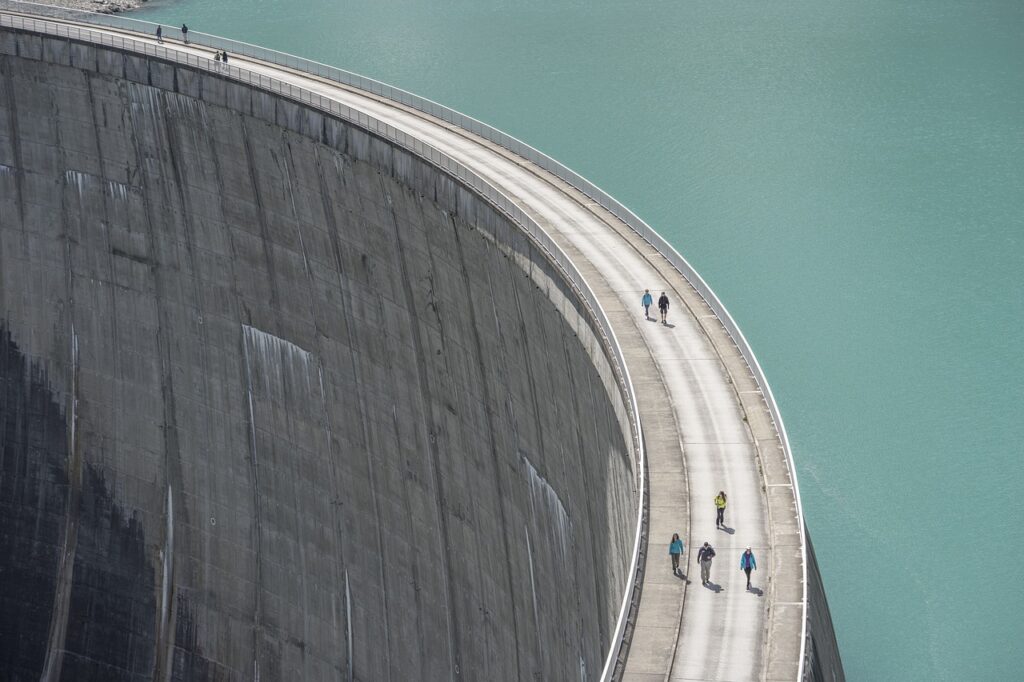
There is a force beneath the surface of our world that has quietly powered human progress for over a century. It is not fire, wind, or the sun. It is water, moving with a purpose that engineers have learned to capture and convert into the electricity that lights our cities and runs our machines. Hydroelectric power is often described as a renewable energy source, but that label undersells its true significance. It is a marriage of natural physics and human design, a system where a river’s gentle flow or a reservoir’s immense weight becomes a reliable current of power.
The mechanics are deceptively simple. A dam holds back water, storing potential energy in the sheer volume and height of the liquid behind it. When that water is released, it rushes downward through penstocks, the massive pipes that channel the flow toward a turbine. The force of the water spins the turbine blades, and that rotational motion drives a generator, producing electricity. The height of the dam and the amount of water stored are the two variables that dictate how much energy can be drawn from the system. A tall dam with a massive reservoir holds far more potential than a small run-of-river installation.
But the turbine is where the magic truly happens. Not all turbines are created equal. Francis turbines are the workhorses of the industry, adaptable to a wide range of conditions. Kaplan turbines, with their adjustable blades, excel in low-head, high-flow environments, while Pelton turbines are reserved for high-head sites where water falls from great heights in narrow streams. Each type is engineered to squeeze every possible drop of kinetic energy from the water, and modern designs achieve efficiency rates of up to 90 percent. That is a remarkable number, especially when compared to other forms of power generation.
Yet, for all its elegance, hydroelectric power is not without its shadows. The creation of a reservoir can drown forests, displace communities, and disrupt the natural flow of rivers, altering ecosystems in ways that are difficult to reverse. Fish migration patterns are interrupted, and water quality can shift as organic matter decomposes underwater. These are real costs, and they demand honest consideration. However, when planned with care, hydroelectric facilities offer more than just electricity. They provide flood control, irrigation for agriculture, and recreational spaces for the public. Newer technologies, such as fish-friendly turbines and improved sediment management, are steadily reducing the environmental toll, making the technology more sustainable than ever before.
From an economic perspective, hydroelectric power is a long-term investment that pays off. The initial construction costs are high, but once the infrastructure is in place, the cost of generating electricity is remarkably low. It is no surprise that hydroelectricity remains the largest source of renewable power on the planet. Countries like Norway, Brazil, and China have embraced it wholeheartedly, and their grids rely on it as a stable backbone. As the world pivots away from fossil fuels, the demand for such reliable, clean energy will only intensify.
Hydroelectric power is more than a technical achievement. It is a reminder that human ingenuity can work with nature rather than against it. Every time a turbine spins, it is a small victory in the fight against climate change, a step toward a future where our energy needs are met without sacrificing the planet we call home. The water that flows through these systems has been doing so for millennia, and now it carries with it the promise of a sustainable tomorrow. That is a story worth telling, and one that is still being written.