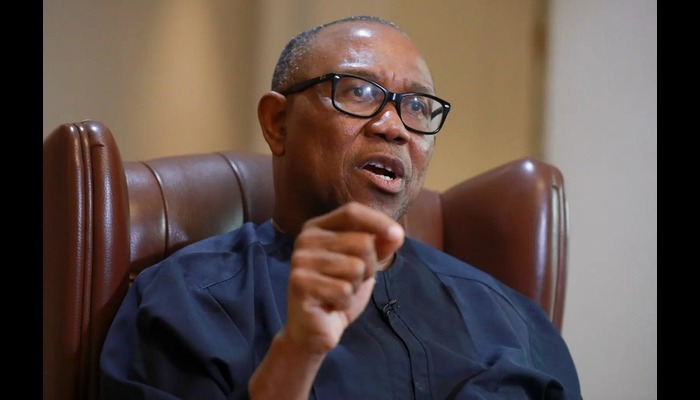
Peter Obi, presidential candidate of the Nigeria Democratic Congress (NDC), has unveiled a region-by-region economic strategy for Nigeria, promising to leverage the comparative advantages of each part of the country to drive production, investment, employment and shared prosperity if elected in 2027.
Obi said the North-West would be positioned to expand agriculture, livestock, irrigation, agro-processing and manufacturing, while the North-East would focus on reconstruction, livelihood restoration, agriculture, education, enterprise and regional Trade.
Speaking on Friday at a press conference to mark the commencement of the 2027 presidential and National Assembly campaigns, Obi said the North-Central would strengthen food production and processing while developing its mineral resources responsibly.
He said the South-West would build on its existing strengths in manufacturing, technology, finance, trade and the creative Economy, while the South-East would leverage its entrepreneurial and industrial base through improved infrastructure, stronger connectivity and greater access to investment.
For the South-South, Obi said the focus would be on extracting greater value from oil and gas while expanding maritime services, fisheries and agriculture, supported by stronger environmental protection.
He also said the Federal Capital Territory should become a model for efficient urban planning, transportation, housing, sanitation, security and public services.
“Every region must produce. Every region must contribute. Every region must benefit,” Obi said.
The regional strategy forms part of Obi’s broader economic agenda, which seeks to move Nigeria from what he described as a consumption-driven economy towards production, processing, investment and enterprise.
North-West to drive agriculture, manufacturing
Obi identified the North-West’s agricultural and livestock potential as key economic assets that could be expanded through investment in irrigation, agro-processing and manufacturing.
He said the region’s economic development must be accompanied by stronger education and security systems to enable farmers, businesses and young people to participate productively in the economy.
His proposal comes as insecurity continues to affect farming and movement of agricultural goods in parts of northern Nigeria, raising concerns about food production and the cost of food.
Obi said securing farming communities would be a central component of his wider economic strategy.
“Farmers cannot produce food if they cannot reach their farms safely,” he said.
Reconstruction for North-East
For the North-East, Obi proposed a development strategy centred on reconstruction and restoration of livelihoods, alongside increased investment in agriculture, education, enterprise and regional trade.
The former Anambra State governor said economic recovery in the region would require rebuilding communities affected by conflict and creating opportunities for residents to return to productive activity.
He said education and enterprise development would be particularly important in providing young people with alternatives to criminal recruitment.
Food production, minerals in North-Central
Obi said the North-Central region should strengthen its position as a major food-producing area while developing its mineral resources responsibly.
He proposed greater emphasis on food processing to enable the region to capture more value from agricultural production rather than simply selling raw commodities.
At the national level, Obi said Nigeria must “produce more of what we consume” and “process more of what we produce” to reduce dependence on imports and improve its competitiveness in global markets.
Read also: 2027: Nigeria’s rural security crisis threatens to shrink grassroots campaign, voting
South-West to leverage industrial base
Obi said the South-West could expand its economic contribution by building on its existing strengths in manufacturing, technology, finance, trade and the creative economy.
The region, particularly Lagos, has a significant concentration of businesses and financial institutions, while its manufacturing and technology ecosystems provide opportunities for further private-sector investment.
Obi said the government’s role would be to create the infrastructure, regulatory environment and institutional conditions required for businesses to invest, hire and expand.
“We will create a business environment where entrepreneurs can invest, hire, and grow without unnecessary regulatory or infrastructure barriers,” he said.
South-East to strengthen entrepreneurship
Obi said the South-East’s entrepreneurial and industrial capacity could be expanded through better infrastructure, stronger connectivity and improved access to investment.
He said the region’s economic potential should be integrated more effectively into the national economy through infrastructure that enables businesses to move goods, access markets and attract capital.
The NDC candidate said Nigeria’s regional economic differences should not be viewed as weaknesses but as opportunities to build complementary productive capacities across the country.
“Nigeria’s diversity is an economic strength,” he said.
South-South to move beyond crude oil
Obi said the South-South should seek greater value from its oil and gas resources while developing other productive sectors.
He identified maritime services, fisheries and agriculture as areas with potential for expansion and said stronger environmental protection would be required alongside economic development.
The proposal reflects his broader argument that Nigeria should move away from dependence on the export of raw commodities and develop industries capable of processing resources locally.
According to Obi, the country should transform its natural resources into value-added industries and its large domestic market into an engine for investment and enterprise.
FCT as model for urban development
Obi said the Federal Capital Territory should demonstrate how efficient public administration and urban planning can improve quality of life.
He identified transportation, housing, sanitation, security and public services as areas where the FCT could set a national standard.
He said effective governance should be measured by outcomes rather than the volume of government activity.
“Reform is not the goal; better lives are,” he said.
From regional strengths to national production
Obi said the regional strategy would form part of a broader shift from consumption to production.
He argued that Nigeria’s population of more than 200 million represents a major domestic market and labour force that could support sustained economic growth if properly harnessed.
“Nigeria cannot import its way to prosperity,” he said. “We will produce more of what we consume, process more of what we produce, and compete more effectively in global markets.”
He said agriculture, manufacturing, technology, construction, energy, creative industries and services all have roles to play in building a more productive economy.
Obi also promised to manage public finances with greater discipline, saying government spending should have a clear purpose and major public investments should have…