

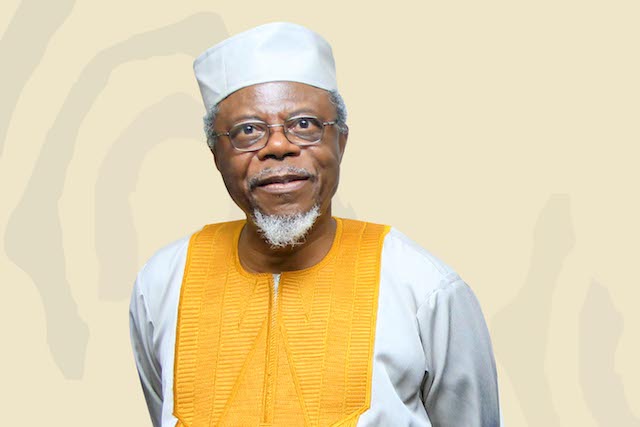
Former Minister of Foreign Affairs Prof. Bolaji Akinyemi explained on Thursday why U.S. President Joe Biden has not pardoned his predecessor, Donald Trump, amid the former president’s ongoing court trials. Trump pleaded not guilty on Tuesday to 34 felony counts in a packed New York courtroom, becoming the first American president to be arrested on criminal charges, AFP reported. After a stern glare at the waiting press, he spent about an hour in the Manhattan courtroom, voluntarily surrendering over allegations involving hush‑money payments that have already upended the 2024 White House race, where he leads the Republican field. “Not guilty,” Trump said clearly, sitting with his shoulders up to his ears, at times looking annoyed but mostly listening cooperatively. He denied all charges related to payments intended to silence people, including an alleged affair with an adult‑film actress.
In an interview on Arise Television, Akinyemi said Trump’s conduct is responsible for the continuation of his trial. He noted that both Gerald Ford and Richard Nixon were Republicans, and that Nixon appointed Ford as his vice‑president after Nixon became embroiled in a bribery scandal and was convicted, leaving the vice‑presidency vacant. “Mr. Ford might have felt he owed Nixon something,” Akinyemi suggested, recalling the Watergate episode that shocked the United States. He argued that even many Democrats agreed with Ford that Americans should see a president put on trial, handcuffed, and marched to jail, given Nixon’s clear involvement in Watergate. “That is why Mr. Ford pardoned Nixon,” Akinyemi said.
Akinyemi questioned why Biden would not pardon Trump, adding that he struggles to find anyone who speaks positively about the former president. “Has he admitted he might have done something wrong? No. Instead, look at what he has done,” he asserted. He pointed out that a judge refused to issue a gag order out of respect for Trump but warned him to be careful about his statements. After returning to Florida, Trump allegedly abused the district attorney, the judge, the judge’s wife, and the judge’s daughter—people the judge had respected enough not to gag. “If I were the judge, I would have him back before me and issue a gag order,” Akinyemi said, noting that officials might be trying not to inflame the situation. “Trump is Trump. Let him say whatever he wants, but that would be dangerous because he can incite people to commit crimes.”
Akinyemi cited examples: when the FBI searched Trump’s Florida home for classified documents, Trump lambasted the agency with insults. The following week, a lone gunman attacked an FBI building, injuring people—a consequence Akinyemi attributes to Trump’s influence on his supporters. He concluded that a gag order should be issued, and if Trump disobeys it, he should be incarcerated.
Comments are closed for this story.