
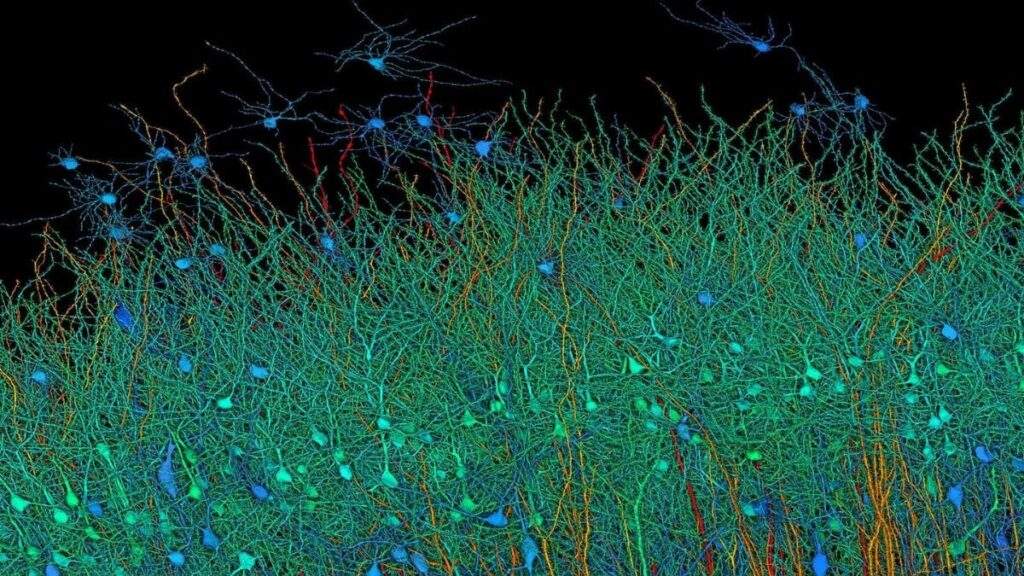
Unveiling the Most Detailed Map of Human Brain Connections
In a groundbreaking collaboration between Harvard University and Google, scientists have successfully created the most detailed map of human brain connections to date. This remarkable achievement focuses on a cubic millimetre of the cerebral cortex, extracted from a patient during epilepsy surgery in 2014. The analysis of this small tissue sample, containing 57,000 cells and 150 million synapses, has taken over a decade to complete and marks a significant advancement in brain science.
To create this map, the team utilized advanced mapping techniques. The process began by staining the brain tissue with heavy metals, which bind to lipid membranes in cells, making them visible under an electron microscope. The tissue was then embedded in resin and sliced into extremely thin sections, just 34 nanometers thick. This method converted a complex 3D problem into a more manageable 2D one, resulting in a colossal dataset of 1.4 petabytes.
To piece together the 2D slices into a coherent 3D model, the team employed machine-learning algorithms developed in collaboration with Google. This involved aligning the images and automatically segmenting the different cell types, with manual adjustments made to refine the accuracy of these segments.
The resulting map has revealed a wealth of information about the brain’s cellular structure. It has identified neurons with over 50 synapses, a detail previously overlooked and potentially crucial for understanding cortical processing. However, the project faces challenges, such as manually verifying the vast amount of data to correct segmentation errors. Some cells, like unidentifiable egg-shaped structures and tangled cells, remain enigmatic and may require further investigation.
The brain map is now publicly accessible, opening up new avenues for research and holding promise for advancing our understanding of mental health disorders, such as schizophrenia. This breakthrough could also inspire improvements in AI by mimicking brain functions. Future projects will include expanding this research to whole mouse brains and additional human brain regions, potentially leading to further breakthroughs in neuroscience and related fields.



Comments are closed for this story.