
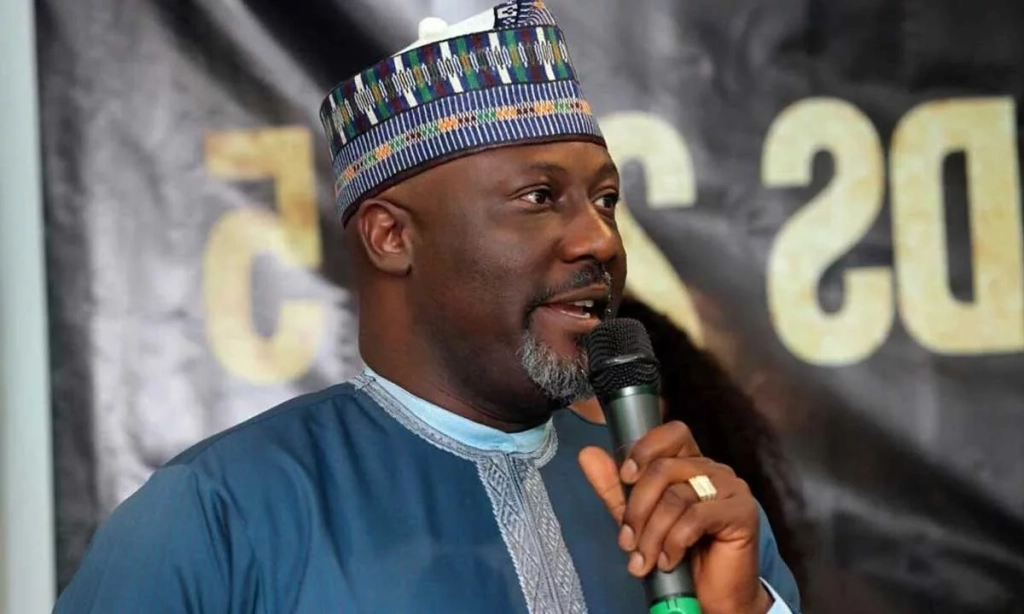
A prominent Nigerian opposition figure has sharply criticized the country’s ruling party, framing its governance as deeply damaging to the nation’s progress. Dino Melaye, a senior member of the African Democratic Congress (ADC) and former senator representing Kogi West, declared during a televised interview that former Vice President Atiku Abubakar is spearheading efforts to counter what he described as the “satanic manifestation” of the All Progressives Congress (APC) government.
Speaking on Channels Television’s Politics Today program on Friday, Melaye accused the APC of inflicting prolonged hardship on Nigerians, asserting that Abubakar—a key opposition leader and two-time presidential candidate—is mobilizing leaders of “honour and valour” to address systemic failures. Though Abubakar has not formally announced a bid for the 2027 elections, Melaye framed his activities as a broader mission to “rescue” Nigeria. The former senator’s remarks reflect mounting friction within the political landscape as the 2023 election’s aftermath continues to reverberate.
Melaye, once a vocal APC supporter, expressed stark regret for his past alignment with the party, which has governed Nigeria since 2015. “I regret bringing APC to power, and through the Lord’s prayer, I confess my sins,” he said, adding that anyone associated with the party’s “unholy tendency” should similarly reconsider. His critique extended to Nigeria’s current conditions, which he characterized as unprecedented in their severity. “It is visible to the blind and audible to the deaf that we are in a precarious situation in this country; it has never been this disastrous and terrible,” he stated, invoking religious imagery to underscore his disillusionment: “Once I was blind, now I can see.”
The APC has yet to formally respond to Melaye’s allegations. However, the party has consistently defended its record, citing infrastructure projects and economic reforms amid global challenges such as inflation and regional insecurity. Critics, however, argue that living standards have deteriorated under its tenure, with Nigeria grappling with a weakening currency, widespread unemployment, and rising food costs.
Melaye’s shift from APC insider to outspoken critic mirrors broader political realignments ahead of the next election cycle. His endorsement of Abubakar—who contested the 2023 presidential race under the Peoples Democratic Party (PDP)—highlights efforts to consolidate opposition forces against the APC. Analysts note that such alliances could reshape Nigeria’s electoral dynamics, though internal divisions within opposition groups remain a persistent challenge.
The remarks arrive as public frustration grows over economic strain and security concerns, with protests erupting sporadically across the country. While Melaye’s rhetoric is emblematic of Nigeria’s polarized political discourse, his call for accountability resonates with citizens demanding tangible improvements in governance. As the 2027 elections approach, the interplay between political defections, coalition-building, and public sentiment will likely dominate national conversations.
Comments are closed for this story.