
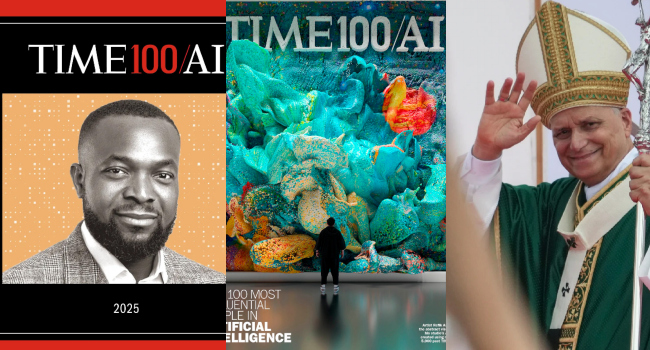
Nigeria’s Minister of Communications, Innovation, and Digital Economy, Bosun Tijani, has been named one of the honourees on TIME Magazine’s annual TIME 100 AI list for 2025. The list recognises 100 individuals who are shaping the future of artificial intelligence, ranging from faith leaders and tech innovators to government officials.
Other notable honourees include Pope Leo XIV, the leader of the Catholic Church, and Sheikh Tahnoun bin Zayed Al Nahyan, the UAE national security adviser and chair of G42. The roster also features tech executives such as Elon Musk, Sam Altman, Mark Zuckerberg, Fidji Simo, and Liang Wenfeng, underscoring AI’s reach across sectors.
Bosun Tijani’s inclusion stems from his efforts to apply entrepreneurial experience to Nigeria’s tech policy. As minister, he leads the 3 Million Technical Talent (3MTT) program, which aims to provide skills training for three million Nigerians by 2027. The initiative has already trained nearly 300,000 people through a digital platform and 220 learning centres, and it connects trainees to jobs via partnerships.
Pope Leo XIV’s presence on the list highlights the intersection of faith and technology. In his inaugural speech, he described AI as a “new industrial revolution” that requires safeguards for human dignity, justice, and labour. Under his leadership, the Vatican has hosted conferences on AI, ethics, and corporate governance, and he has urged tech leaders to prioritise ethics.
Sheikh Tahnoun bin Zayed Al Nahyan is driving the UAE’s AI ambitions as chair of G42, a firm building AI supercomputers through partnerships with Microsoft and Cerebras Systems. The UAE aims to become an AI superpower by 2031 and has pledged a $1.4 trillion investment in American AI infrastructure over the next decade.
The list also includes other government figures advancing AI in developing nations, such as Paula Ingabire, Rwanda’s Minister of ICT and Innovation, who expects AI to add at least 6 % to the country’s GDP. The TIME 100 AI list highlights AI’s growing importance in addressing global challenges—from economic development to ethical governance.
Selection involved nominations from experts and past honourees, and the full list is available on TIME.com. The list avoids ranking; instead, it groups individuals by categories such as leaders, innovators, and shapers. The diverse backgrounds and sectors represented reflect the maturation of AI and its potential to address inequality, while also emphasizing the need for governance and ethics in its development and deployment.



Comments are closed for this story.