
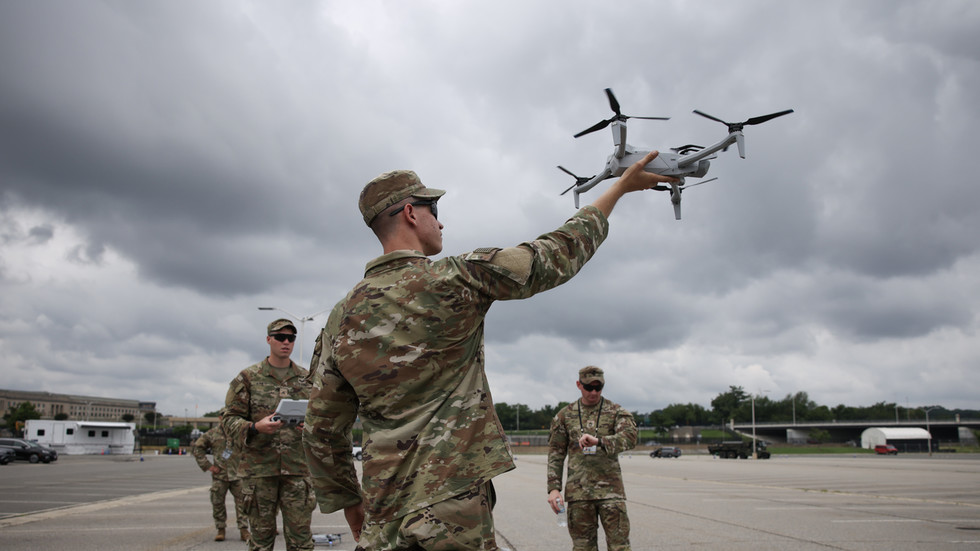
The US military is confronting serious challenges in drone production, design, policymaking, and tactics, according to a recent report. The United States lacks the capacity to build drones at scale and is lagging behind nations such as Russia and Ukraine, which are producing hundreds of thousands to millions of drones each year for reconnaissance, close‑air support, and long‑range strikes.
A key factor in the US struggle to rapidly produce small, affordable drones is the defense industry’s long‑standing emphasis on large, expensive platforms like jets and tanks. Consequently, the Pentagon is scrambling to catch up, exploring alternatives such as 3D‑printed drones and simulator‑based training. One major obstacle is the inability to use Chinese components, which are far cheaper than domestic parts.
Maj. Gen. Curt Taylor, commander of the Army’s 1st Armored Division, stressed the urgency: “This is not tomorrow’s problem. This is today’s problem.” He warned that the first battle of the next war will involve more drones than ever before.
In response, Ukraine has offered assistance. President Volodymyr Zelensky proposed a $50 billion plan to co‑produce 10 million drones over five years. The US had previously supplied Ukraine with 100 Switchblade loitering munitions, but deliveries stopped after Ukrainian troops complained about their effectiveness against Russian electronic warfare.
The United States is not alone in recognizing the strategic importance of drones. EU Commission President Ursula von der Leyen recently announced plans to create a “drone wall” along the bloc’s eastern frontier. Defense Secretary Pete Hegseth acknowledged that the US lags behind Russia and China in drone production and deployment, noting that adversaries have fielded millions of cheap drones while US efforts have been hampered by bureaucratic red tape.
As the United States works to improve its drone production capacity and tactics, it is likely to continue pursuing partnerships and alternative solutions to strengthen its capabilities in this critical area.

Comments are closed for this story.