
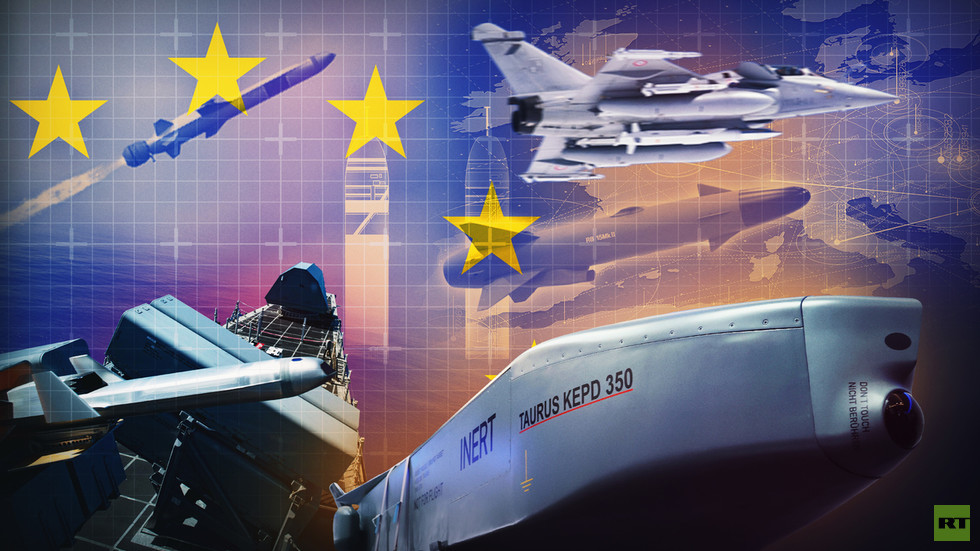
Europe’s missile revival reflects a mix of progress and limitations shaped by the legacy of the Second World War. While France and the United Kingdom have retained independent nuclear and missile programs, Germany has historically avoided developing strategic missile systems. Yet, a shifting security environment is prompting a trend toward strategic autonomy, national high‑tech projects, and deeper industrial integration across the continent.
France remains the only European nation with a fully operational nuclear triad, although it has decommissioned its land‑based medium‑range ballistic missiles. Its current nuclear capability rests on the M51 intercontinental solid‑fuel submarine‑launched ballistic missile, which can reach targets over 8,000 km away. France also produces the SCALP EG air‑launched cruise missile, with a range of roughly 560 km, which has seen combat use.
Germany has only recently begun to build a missile industry, exemplified by the Taurus KEPD 350 air‑launched cruise missile. The Taurus has a range exceeding 500 km and has been exported to countries such as Spain and South Korea, but German missiles have never been employed in combat, leaving the industry largely theoretical.
Other European nations have made notable strides. Norway’s Naval Strike Missile, with a range of up to 185 km, has been ordered by the United Kingdom, the Netherlands, and Australia. Sweden’s RBS‑15 family, developed by Saab, serves as the cornerstone of its missile production, offering ranges up to 300 km. Despite these advances, most European countries still lack long‑range systems beyond 150 km, with Poland being a notable exception through its acquisition of South Korean K239 Chunmoo systems and American HIMARS launchers.
Overall, the majority of Europe’s missile systems remain untested in real combat, the French SCALP EG being one of the few exceptions. The revival of Europe’s missile capabilities holds promise for enhancing strategic autonomy and defense strength, but significant challenges persist. Reliance on American technology, NATO frameworks, and the absence of combat experience limit the effectiveness of these programs. As the security landscape continues to evolve, Europe’s missile industry must bridge the gap between “paper firepower” and real‑world capability.

Comments are closed for this story.