
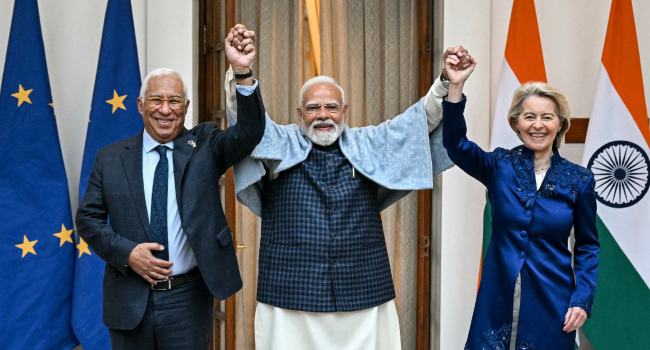
India and the European Union have announced a landmark trade agreement, creating a massive market of two billion people after two decades of negotiations. The pact aims to shield both parties from challenges posed by the world’s leading economies, the United States and China.
The agreement will eliminate or reduce tariffs on nearly 97% of European exports, resulting in annual savings of up to 4 billion euros ($4.75 billion) in duties. This development is expected to bring numerous opportunities for India’s 1.4 billion people and millions of EU citizens. The pact represents about 25% of global GDP and one-third of global trade.
The EU has long viewed India, the world’s most populous nation, as a vital market for the future. European Commission President Ursula von der Leyen stated that “Europe and India are making history today” by creating a free trade zone of two billion people, with both sides set to benefit. The deal is considered the most ambitious India has ever signed, with European companies poised to gain a “first mover advantage.”
Key sectors in Europe, including agriculture, automotive, and services, are expected to gain from the agreement. India, on the other hand, sees the European bloc as a crucial source of technology and investment to rapidly upscale its infrastructure and create millions of new jobs. Bilateral trade in goods reached 120 billion euros ($139 billion) in 2024, with a further 60 billion euros ($69 billion) in trade in services.
Under the agreement, India is expected to ease market access for key European products, including cars, wines, and processed foods. Tariffs on these products will be gradually lowered, with some being eliminated altogether. The EU expects exports to India to double, with the bloc gaining the “highest level of access ever granted to a trade partner” in the traditionally protected Indian market.
The accord comes as both Brussels and New Delhi seek to open up new markets in the face of US tariffs and Chinese export controls. India and the EU are also expected to conclude an agreement to facilitate movement for seasonal workers, students, researchers, and highly skilled professionals, as well as a security and defense pact. The partnership is seen as a strategic choice, showcasing a commitment to dialogue and openness in a fractured world. With India on track to become the fourth-largest economy this year, the agreement is expected to have significant implications for global trade and economic relations.



Comments are closed for this story.