
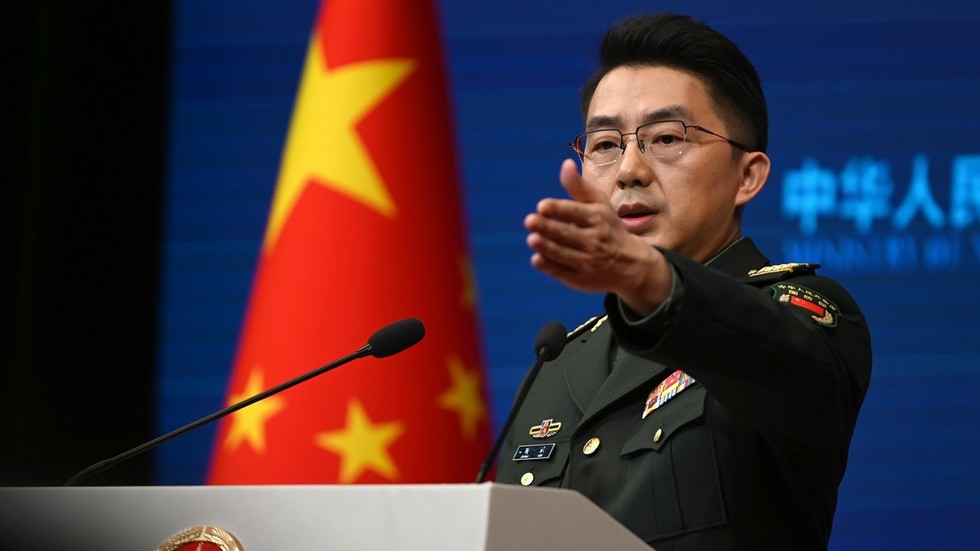
China has issued a stern warning that any preemptive strike by Taiwan using US-supplied missile systems would trigger an overwhelming military response, describing such actions as a path to “certain annihilation.” The statement from Chinese military spokesman Jiang Bin follows reports that Taiwan’s government is considering deploying advanced rocket artillery to outlying islands closer to the mainland.
The plans centre on the M142 High Mobility Artillery Rocket System (HIMARS) and its long-range ATACMS ballistic missiles, which Taipei secured as part of a $11.1 billion US arms package announced in December. The 300-kilometre range of the ATACMS munitions means potential deployment to the Penghu archipelago or Dongyin islet could place key Chinese coastal military facilities in Fujian and Zhejiang provinces within striking distance.
Spokesman Jiang Bin criticised the forward deployment concept as “increasingly absurd and overconfident,” suggesting the idea was promoted by pro-independence elements risking provocation. His comments reflect Beijing’s consistent stance that US arms transfers to Taiwan embolden separatist actors and destabilise cross-strait relations.
The backdrop is Taiwan’s acquisition of 82 HIMARS launchers and 420 ATACMS missiles. While Taipei has not formally confirmed deployment to the frontline islands, the possibility has been highlighted by security analysts and tracked by outlets such as the Taiwan Security Monitor. The systems’ proven mobility and precision, demonstrated in conflicts like Ukraine, represent a significant shift in Taiwan’s defensive calculus.
China’s response underscores its long-held position that it reserves the right to use force to prevent formal Taiwanese independence. The self-governing island, which has been separately administered since the 1949 Chinese civil war, relies on US strategic ambiguity for its security. Recent Chinese naval exercises near Taiwan have included simulations of strikes against such mobile missile units.
The situation highlights the delicate military balance in the Taiwan Strait. While Taiwan seeks to bolster its asymmetric deterrent capabilities, Beijing views any enhancement of Taiwan’s offensive potential—even if framed as defensive—as a direct threat to its sovereignty. The deployment of HIMARS to the outlying islands would fundamentally alter the tactical landscape, compressing warning times for mainland defences and potentially raising the risk of rapid escalation in a crisis.
Diplomatic observers note that the current tension occurs within a broader pattern of stepped-up Chinese military pressure and parallel US arms support for Taiwan. The next steps will likely involve official Taiwanese decisions on force posture, continued Chinese diplomatic protests, and potential adjustments in US arms sales policy. The episode reaffirms how conventional weapons transfers remain a flashpoint in one of the world’s most closely watched security dilemmas.


Comments are closed for this story.