
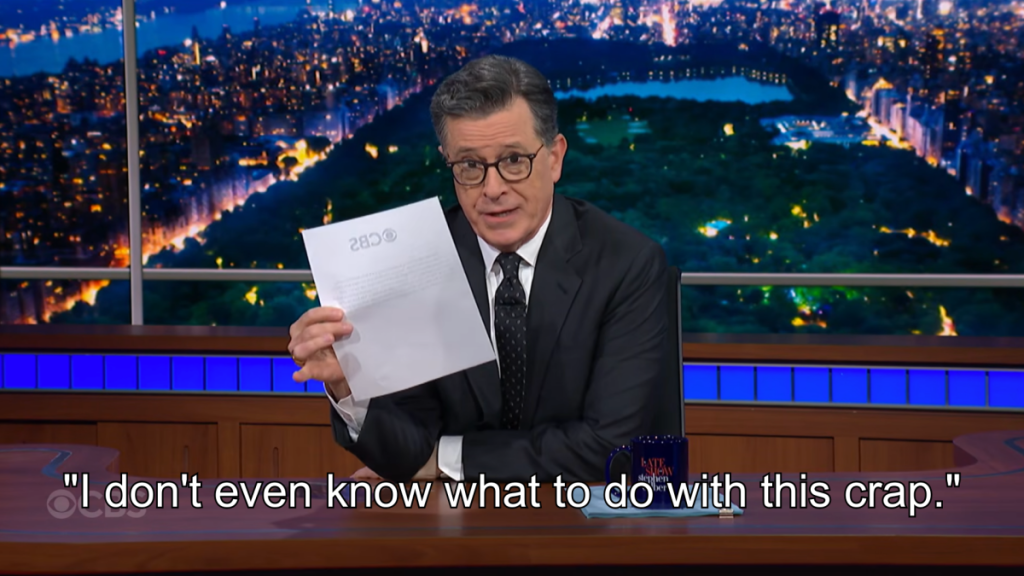
Stephen Colbert has directly challenged CBS Corporation’s denial that it prevented his interview with Texas Representative James Talarico from airing on The Late Show last week, dismissing the network’s statement as inaccurate. The confrontation highlights a significant dispute over the application of U.S. broadcast regulations to late-night television.
In a statement released Tuesday, CBS asserted it did not prohibit the interview’s broadcast. The network explained it provided The Late Show with legal guidance that airing the interview could trigger the Federal Communications Commission’s (FCC) equal-time rule. This rule requires broadcasters to offer comparable airtime to opposing political candidates. CBS said it presented options for fulfilling this requirement, and the show opted to publish the interview on YouTube with an on-air promotional mention instead.
Colbert, however, contested this account during his Monday broadcast. He stated he was unaware of any prohibition until after the show, when CBS issued its press release without consulting him or his team. “I was ready to let the whole thing go… until a few hours ago, when my group chat blowed up. Because, without ever talking to me, the corporation put out this press release,” Colbert said.
The host argued that CBS’s actions misrepresented the core issue. He emphasized that he did not require the network’s legal team to suggest booking other guests, as he has previously hosted Representative Jasmine Crockett, one of the candidates cited by CBS. More critically, Colbert asserted that CBS unilaterally enforced an obligation he has never faced in his 21-year career. He noted that talk shows have long operated under a well-established regulatory exemption from the FCC’s equal-time rule for news interviews and similar programming.
“That decision… is their right,” Colbert conceded. “Just like I have the right to talk about their decision on air.” He expressed particular bafflement that CBS lawyers, who routinely approve every script, had specifically approved the language he used to describe the equal-time exemption during the broadcast in question. “They told us the language they wanted me to use… And I used that language,” he stated.
Industry analysts note that Colbert’s team has been unable to identify any precedent for enforcing the equal-time rule against a talk show interview segment since the 1960s. The FCC’s current chair, Brendan Carr, has previously advocated for eliminating the news/interview exemption, though it remains in effect. CBS’s pre-emptive application of the rule, therefore, represents an uncommon and potentially consequential interpretation of broadcast law.
The dispute raises questions about the balance between corporate legal compliance and the editorial autonomy of late-night programming. While CBS maintains it followed standard legal protocols, Colbert frames the network’s post-broadcast statement as a public rebuke that contradicts its prior approval. The situation may prompt broader discussion within the television industry about the scope of the FCC’s equal-time exemption for news-oriented talk shows and the level of consultation expected between network legal departments and program producers.




Comments are closed for this story.