
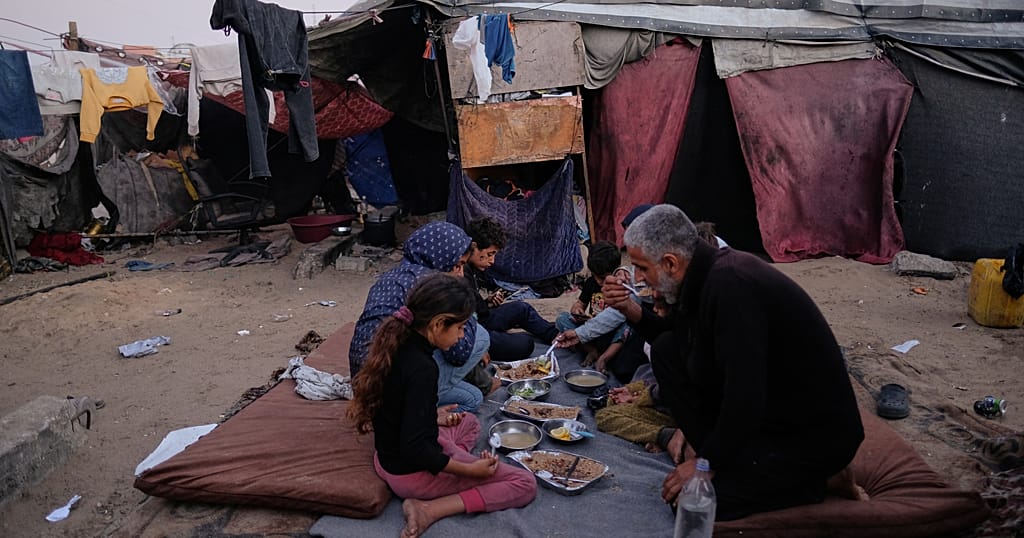
Despite ongoing humanitarian shortages, Gazans are observing the holy month of Ramadan with resilience, relying on community support networks as basic supplies remain severely limited. The festivities unfold against a backdrop of economic collapse and repeated displacement, with a fragile ceasefire frequently tested by violations.
In the Gaza Strip, where the pre-war economy was heavily dependent on external aid, the current conflict has decimated local markets and income sources. Residents report being unable to afford staples like meat and chicken, items traditionally central to Ramadan meals. Instead, neighbours are sharing what little they have. “One day we eat fava beans, another day something else… neighbours are helping each other. One day I offer them a meal, and the next day they do the same for me,” said Asma Abu Shab, a resident. “The circumstances don’t allow us to buy chicken and meat as we used to. There’s no money; we have no income. May God grant us relief.”
This communal coping mechanism highlights the severe deprivation faced by the population. While daily life is marked by hardship, many express hope for an end to the conflict. “We hope that God will resolve our crisis, that the war will end, and that we will return to our homes in peace,” said Maha Al-Hajj.
The current context stems from a ceasefire agreement that took effect in late October, brokered by Qatar, Egypt, and the United States. The truce, which included terms for Israeli withdrawal and reconstruction, has been repeatedly undermined by mutual accusations of violation between Israel and Hamas. The United Nations and aid agencies repeatedly warn that the lack of consistent, unimpeded aid deliveries exacerbates the humanitarian catastrophe.
The conflict has triggered one of the most rapid and large-scale displacement crises in recent history. The majority of Gaza’s population of approximately 2.3 million people has been forced to flee their homes multiple times, often seeking shelter in overcrowded schools, tents, or damaged buildings with minimal sanitation or services. This constant movement disrupts any sense of normalcy, including religious observance.
As Ramadan continues, the combination of food scarcity, economic paralysis, and insecurity underscores the territory’s profound instability. The period traditionally emphasizes charity and community, yet for many Gazans, practising these tenets requires extraordinary effort amid scarcity. The international community’s focus remains on sustaining the ceasefire and scaling up humanitarian aid to prevent further deterioration. The resilience displayed during this holy month is juxtaposed with an urgent need for a lasting political resolution to the underlying causes of the conflict.




Comments are closed for this story.