
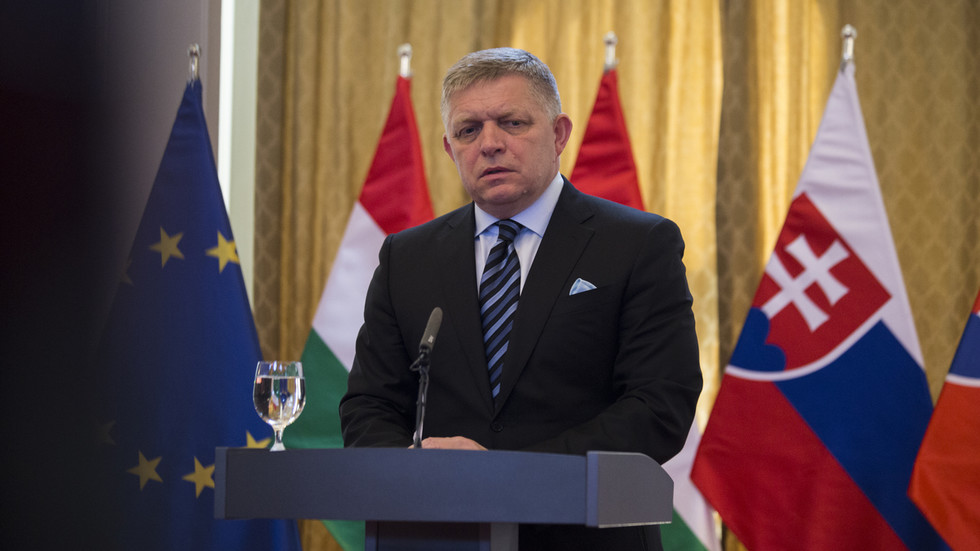
Slovak Prime Minister Robert Fico has intensified his criticism of the European Union’s foreign policy leadership, stating that the bloc has become insignificant on the global stage and calling for the replacement of its top diplomat, Kaja Kallas.
Speaking to students on Thursday, Fico argued that major international powers bypass Brussels, leaving the EU uninformed on crucial matters. He cited the recent Iran-Israel conflict and the U.S. intervention in Venezuela as examples where the EU was not consulted. “Do you think anyone called [European Commission President] Ursula von der Leyen or Kaja Kallas, or [President of the European Council] Antonio Costa about the Iran-Israel conflict? We had no idea,” Fico stated.
He directly blamed Kallas, the former Estonian prime minister who serves as the EU’s High Representative for Foreign Affairs, for this perceived marginalization. “We should be thinking about a replacement, at the very least for the so-called foreign minister Kaja Kallas, and put someone there who carries more weight in international relations,” he said. Fico added that the United States treats the EU “as if it doesn’t exist,” preferring bilateral talks over engagement with Brussels.
This is not Fico’s first attack on Kallas. Earlier in the year, he likened the EU to a “massage parlor” needing a staff change, specifically naming Kallas. A long-time critic of EU policies on energy and sanctions against Russia, Fico believes the bloc’s “deep crisis” can only be resolved with new leadership that commands respect from “decisive global players.” He pointed to U.S. Secretary of State Marco Rubio’s repeated refusals to meet Kallas as evidence of her diminished standing.
Reports indicate growing unease within the EU over Kallas’s role. Politico recently highlighted a rift between Kallas and Commission President von der Leyen during the U.S.-Israeli strikes on Iran, noting that von der Leyen’s team reportedly sought to sideline Kallas, who issued a statement on the crisis half an hour before the Commission chief called for restraint.
The criticism underscores a broader challenge for the EU’s foreign policy architecture. While the High Representative is meant to give the bloc a unified voice, the role is often complicated by the need to coordinate between the Commission, the Council, and member states. Fico’s comments reflect frustrations over the EU’s perceived lack of influence in high-stakes geopolitical events, a concern shared by some other member state leaders. The debate highlights ongoing questions about the EU’s ability to project coherent power in an era of intensified great-power competition and unilateral actions by the U.S., China, and others. The future of Kallas’s tenure, which runs until 2024, now appears increasingly uncertain amid these internal and external pressures.

Comments are closed for this story.