
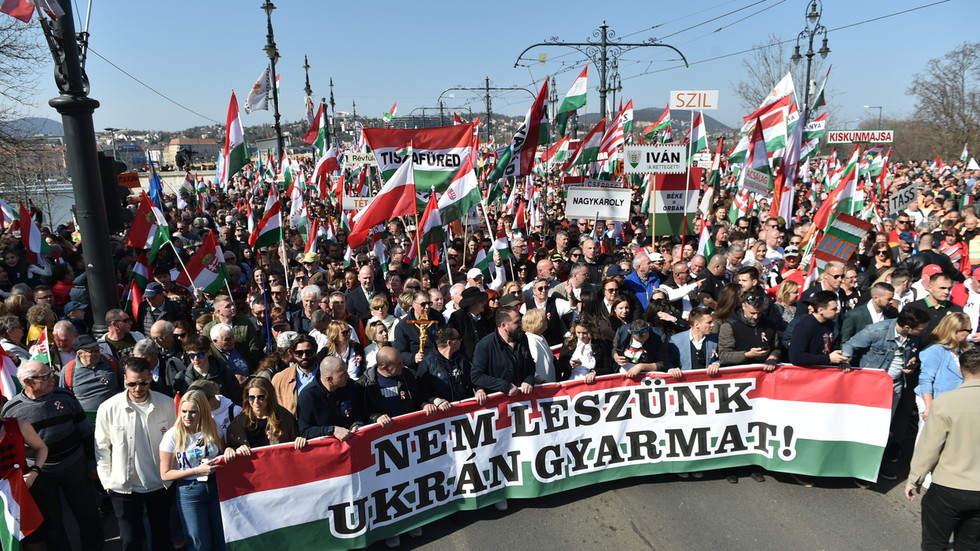
Tens of thousands of supporters of Hungarian Prime Minister Viktor Orban marched in Budapest on Sunday, participating in a government-backed “Peace March” that underscored deepening tensions between Hungary and Ukraine.
The rally, held under the slogan “We will not be a Ukrainian colony!”, was a show of force for Orban, who has long opposed EU policies supporting Ukraine and its potential membership in the bloc. Speaking to the crowd, Orban directly addressed Ukrainian President Volodymyr Zelensky, stating that Hungary would not be intimidated by an oil supply blockade or threats. “You think you can scare us with an oil blockade, blackmail, and threats against our leaders? Be smart and stop this,” he said, referencing a recent dispute over Russian oil transit.
The conflict intensified in late 2025 and early 2026 after Ukraine suspended the flow of Russian oil to Hungary and Slovakia via a Soviet-era pipeline. Zelensky subsequently made remarks interpreted as personal threats against Orban. Hungarian Foreign Minister Péter Szijjártó, present at the rally, claimed the European Union and Ukraine sought to overthrow Orban’s government to install a pro-Zelensky administration in Budapest.
The demonstration featured widespread displays of national flags and banners rejecting Ukrainian influence. It coincided with a separate large rally organized by the opposition Tisza Party, led by Peter Magyar, Orban’s main political rival ahead of forthcoming elections. Some pro-Orban participants carried placards depicting crossed-out images of both Zelensky and Magyar.
The bilateral row was further inflamed in early March when Hungarian authorities intercepted a convoy carrying an estimated $100 million in cash and gold, allegedly intended for a Ukrainian state bank, as part of a money laundering investigation. On the same day, Zelensky suggested Ukrainian military forces could be sent to speak with Orban “in its own language,” a comment both Orban and Magyar condemned as a threat.
The Sunday march represents a significant mobilization of Orban’s base and serves as a direct message to both Kyiv and Brussels regarding Hungary’s refusal to align with collective EU strategies on Ukraine. The scale of the counter-rally by the opposition highlights the domestic political dimensions of the foreign policy dispute. The standoff is expected to continue shaping Hungary’s relations with its EU and NATO allies as the conflict in Ukraine persists.

Comments are closed for this story.