
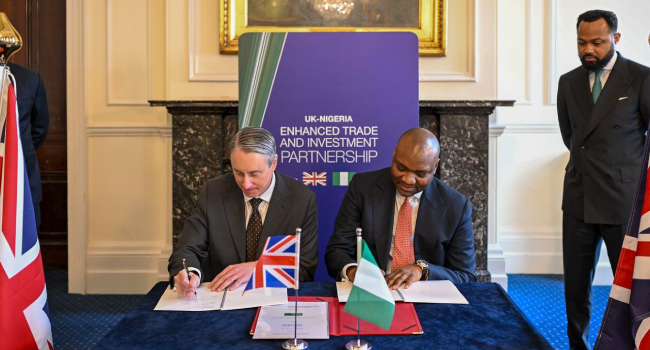
The Nigeria Sovereign Investment Authority (NSIA) and UK-based Asset Green Ltd have signed a Memorandum of Understanding (MoU) to develop a large-scale integrated dairy production and processing platform in Nigeria. The agreement, signed in London ahead of President Bola Tinubu’s state visit to the UK, outlines a partnership for a project valued at nearly US$500 million.
The planned development will combine 20,000 hectares of climate-smart crop and forage farming with a 10,000-cow dairy operation and a modern processing facility. The plant is designed to produce fresh milk, milk powders, butter, cream, and up to 15,000 metric tonnes of infant formula annually. A core objective is to significantly reduce Nigeria’s dependence on imported milk powder.
Once operational, the platform is projected to generate over $620 million in annual revenue and create 2,500 direct and 5,000 indirect jobs. It aims to integrate up to 10,000 rural households into the supply chain through out-grower schemes, modernising agricultural practices and improving nutrition.
British Deputy High Commissioner Jonny Baxter highlighted the project as a “full-circle moment,” referencing the UK’s early support in establishing the NSIA over a decade ago. He framed the partnership as a testament to long-term UK-Nigeria economic cooperation and private-sector driven growth.
NSIA’s Managing Director, Aminu Umar-Sadiq, stated the investment lays the foundation for a modern, competitive dairy sector that reduces import dependence and creates sustainable jobs. Rod Bassett, Director of Asset Green Ltd and CEO of Agrium Capital Ltd, described the greenfield investment as catalytic, noting it will build necessary infrastructure to enhance local production and strengthen national food sovereignty.
The MoU was formalised during President Tinubu’s two-day state visit, which focuses on deepening bilateral relations in trade, investment, and immigration. The diplomatic timing underscores the project’s role in the broader UK-Nigeria partnership.
This initiative represents a major step in Nigeria’s strategy to develop its agricultural sector, enhance food security, and attract significant foreign direct investment into a critical area of the economy. The next phase involves finalising a formal shareholders’ agreement to commence project development.



Comments are closed for this story.