
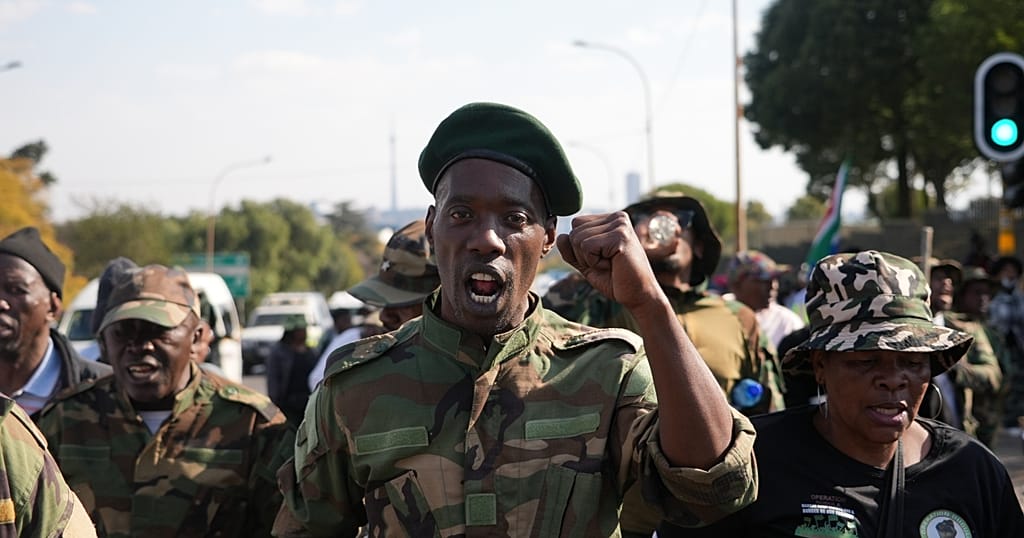
A coalition of anti-immigration groups, including the civic organisation March and March and the political party ActionSA, held a demonstration in Durban on Wednesday, calling for stricter immigration laws, enhanced border controls, and the mass deportation of undocumented foreign nationals. The march, which also involved the vigilante group Operation Dudula, highlighted the persistent and often contentious national debate over migration in South Africa.
The protest, marking the first anniversary of March and March’s public campaigning, saw participants demand that the government take decisive action against irregular migration. The organisation’s leader, Jacinta Ngobese-Zuma, articulated a central grievance, questioning state policy on public service access. “If you are saying you can’t refuse them healthcare for example, why must it be public? Make them pay for their own healthcare if they want to be here in the country milking our resources,” she stated. Such rhetoric, frequently characterised by critics as xenophobic, has been widely condemned by human rights organisations but resonates in communities facing high unemployment.
ActionSA’s leader, Herman Mashaba, a former Johannesburg mayor, explained his party’s participation by criticising the national government’s perceived inaction. “We are seeing our government allowing our country to be flooded by groups from all over the world… So we are saying to our government this is unacceptable,” Mashaba said. He asserted that ActionSA fully supports March and March’s efforts to place the issue “into the public domain.” Individual participants echoed the parties’ messaging. Muzi Xaba, a marcher, claimed undocumented migrants were displacing South African workers, stating a intent to “remove foreigners and then hire South Africans.”
Anti-migrant sentiment in South Africa is often rooted in economic anxieties, with groups like Operation Dudula and March and March alleging that undocumented foreigners exacerbate unemployment, contribute to crime, and strain public services. These claims are made despite a lack of comprehensive national data conclusively linking migration to job losses or increased crime rates. The tensions periodically erupt into violence, most severely during the 2008 xenophobic riots and recurring sporadic attacks.
The Durban march underscores the potent political mobilisation around immigration ahead of the 2024 national elections, where parties are competing for voter support amid a stagnant economy and record joblessness, which sits near 33%. The protest places direct pressure on the Department of Home Affairs and the broader cabinet to enact more punitive measures. However, such demands conflict with constitutional guarantees of human dignity and access to essential services, as well as international obligations.
The demonstration signifies a hardening of public discourse and the mainstreaming of previously fringe anti-immigrant positions. It highlights a significant governance challenge for the state: addressing legitimate socioeconomic concerns while countering xenophobic narratives and safeguarding vulnerable migrant communities. The government’s response, or lack thereof, will likely remain a key indicator of its capacity to manage one of the nation’s most polarising issues.




Comments are closed for this story.