
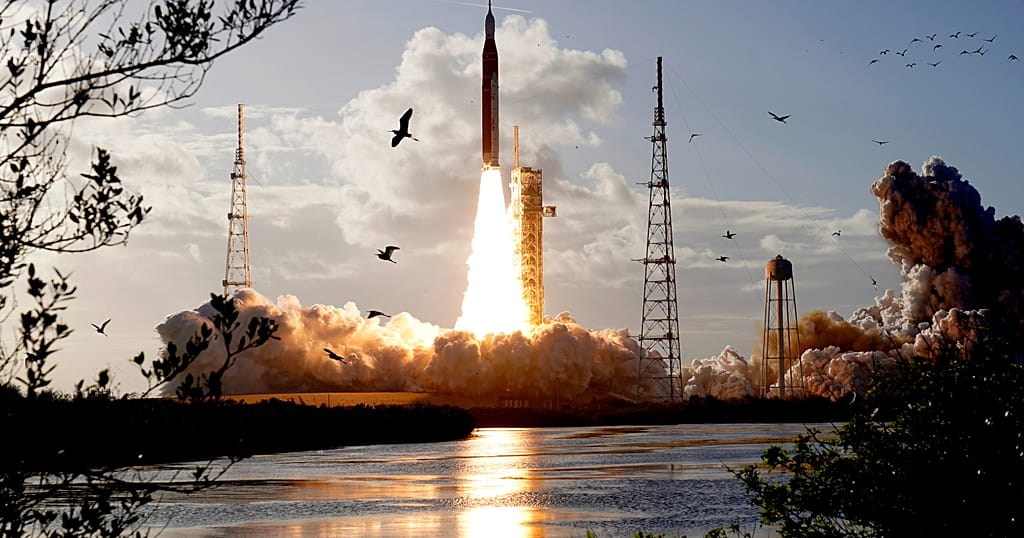
Four astronauts have launched from NASA’s Kennedy Space Center aboard a Space Launch System rocket, beginning the agency’s first crewed lunar flyby in more than half a century. The Orion spacecraft is currently in Earth orbit as the flight team conducts final system verifications before the planned journey toward the Moon.
The mission carries NASA astronauts Reid Wiseman, Victor Glover, and Christina Koch, alongside Canadian Space Agency pilot Jeremy Hansen. Following the evening launch, the crew has initiated critical safety procedures, including complex maneuvers that simulate future docking operations with a lunar lander. Mission control reported minor technical adjustments during the initial phases, including brief system notifications and a short communication interruption. All issues have been resolved, and flight directors confirm the spacecraft is operating within standard parameters.
If upcoming checks proceed as scheduled, Orion will fire its main engines to leave Earth orbit and begin a circumlunar trajectory. The flight is expected to last approximately 10 days, making it one of the longest human spaceflights in NASA history. During the journey, the spacecraft will travel beyond the Moon and record the greatest distance from Earth reached by a crewed mission to date. The team will collect high-resolution imagery and environmental data to support navigation, communications, and deep-space radiation research.
The mission establishes multiple milestones for international spaceflight. It is the first lunar expedition to include a woman, a person of color, and a non-American astronaut. It also serves as the inaugural crewed test of the Space Launch System, which provides the primary transportation infrastructure for NASA’s ongoing lunar exploration program. Engineers will evaluate propulsion performance, thermal shielding durability, and life-support reliability under extended deep-space conditions.
Flight operators will continue tracking all spacecraft systems ahead of the trans-lunar injection maneuver required to reach the Moon. Data collected during this mission will inform landing site preparations and the engineering standards for future surface operations. Mission management maintains current flight protocols as Orion completes its orbital verification schedule.

Comments are closed for this story.