
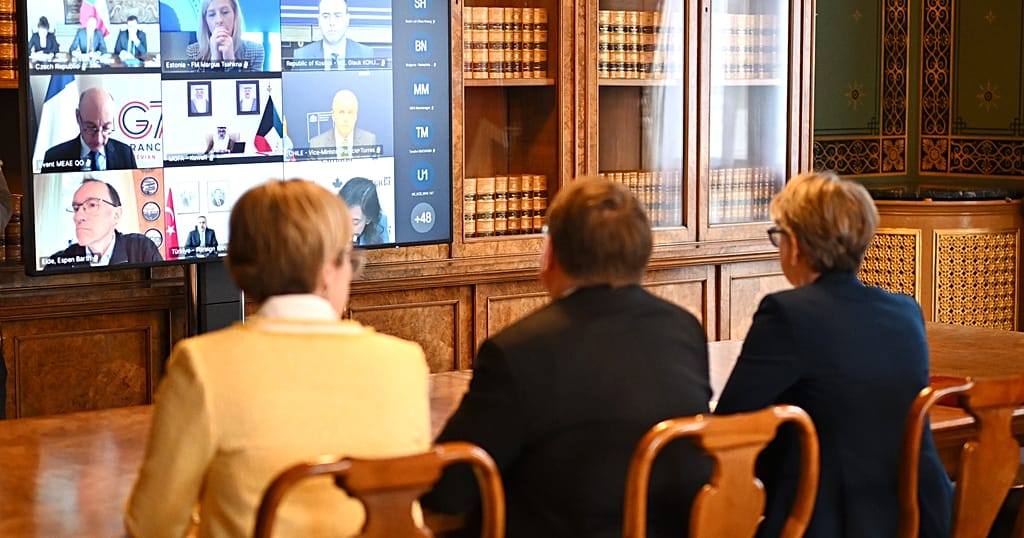
Britain accused Iran on Thursday of holding the global economy hostage as diplomats from more than 40 countries convened to discuss reopening the Strait of Hormuz, a vital shipping route blocked by the ongoing U.S.-Israeli military campaign against Iran.
The United States is not participating in the virtual meeting, following President Donald Trump’s assertion that securing the waterway—closed as a result of the conflict—is not America’s responsibility. Trump has also criticized European allies for insufficient support and renewed threats to withdraw the U.S. from NATO.
U.K. Foreign Secretary Yvette Cooper opened the talks by emphasizing the international community’s resolve to restore safe passage through the strait. She said the discussions focus on political and diplomatic solutions rather than military action.
“We have seen Iran hijack an international shipping route to hold the global economy hostage,” Cooper said. She warned that “unsustainable” spikes in oil and food prices are “hitting households and businesses in every corner of the world.”
More than three dozen countries, including the U.K., France, Germany, Italy, Canada, Japan, and the United Arab Emirates, have signed a joint statement urging Iran to cease its efforts to block the strait. The statement pledges to “contribute to appropriate efforts to ensure safe passage” through the waterway.
Cooper noted that the 40-plus countries at the meeting—up from 35 announced the previous day—discussed “diplomatic and international planning measures” to safely reopen the strait and ensure the safety of 20,000 seafarers aboard 2,000 ships trapped by the conflict.
The talks reflect growing international concern over the economic and humanitarian impact of the blockade, as well as the urgent need for coordinated diplomatic action to restore maritime access through one of the world’s most critical trade routes.

Comments are closed for this story.