
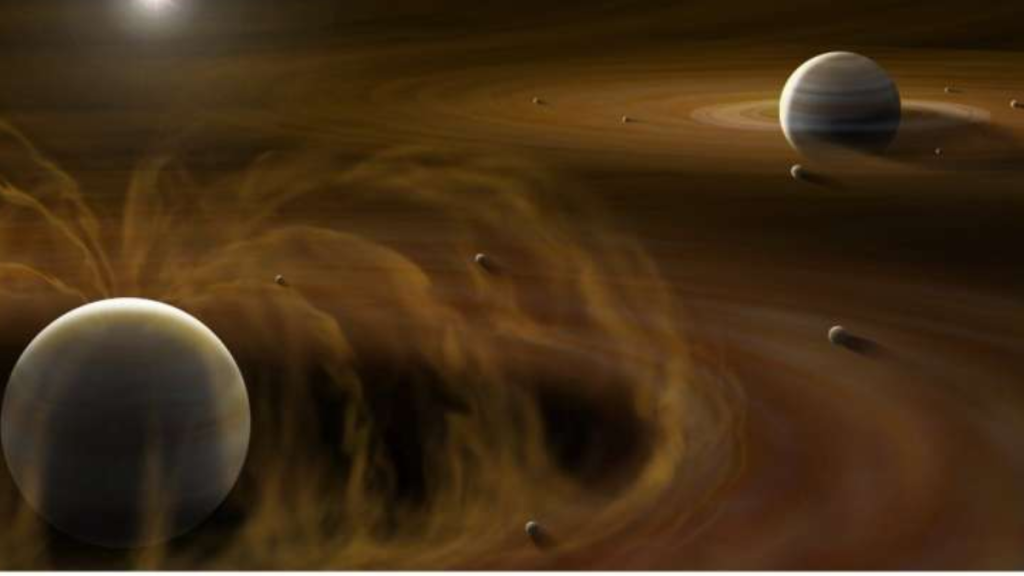
The disparity in the number of large moons between Jupiter and Saturn has long intrigued astronomers, and recent research offers a compelling explanation rooted in the planets’ formation histories. Jupiter, the solar system’s largest planet, boasts four massive moons—Io, Europa, Ganymede, and Callisto—collectively known as the Galilean moons. In contrast, Saturn, despite its size and iconic rings, has only one moon of comparable scale: Titan.
A study published in Science Advances suggests that the key difference lies in the conditions present during each planet’s early development. Jupiter’s formation occurred in a region of the solar system where the temperature and density of the surrounding gas and dust allowed for the rapid accretion of large moons. The intense gravitational pull of the nascent Jupiter drew in vast amounts of material, enabling the creation of multiple substantial satellites in a relatively short period.
Saturn, however, formed in a cooler and less dense environment. This setting limited the amount of material available for moon formation and slowed the process, resulting in the development of fewer, smaller moons. Titan’s exceptional size is attributed to a combination of its own rapid growth and the subsequent depletion of nearby material, which prevented the formation of additional large moons.
The research also highlights the role of orbital dynamics. Jupiter’s strong gravity and the resonant orbits of its moons have helped maintain their stability over billions of years. Saturn’s system, by contrast, has experienced more complex interactions, with some moons being ejected or colliding, further reducing the number of large satellites.
These findings not only clarify the differences between the two gas giants but also provide insights into the broader processes that shape planetary systems. Understanding how and why moons form—and why some planets end up with more than others—can inform the search for exomoons around distant worlds, potentially guiding future astronomical observations.
As scientists continue to study the formation and evolution of moons, the story of Jupiter and Saturn’s satellite systems underscores the diversity of outcomes possible in our cosmic neighborhood.



Comments are closed for this story.