
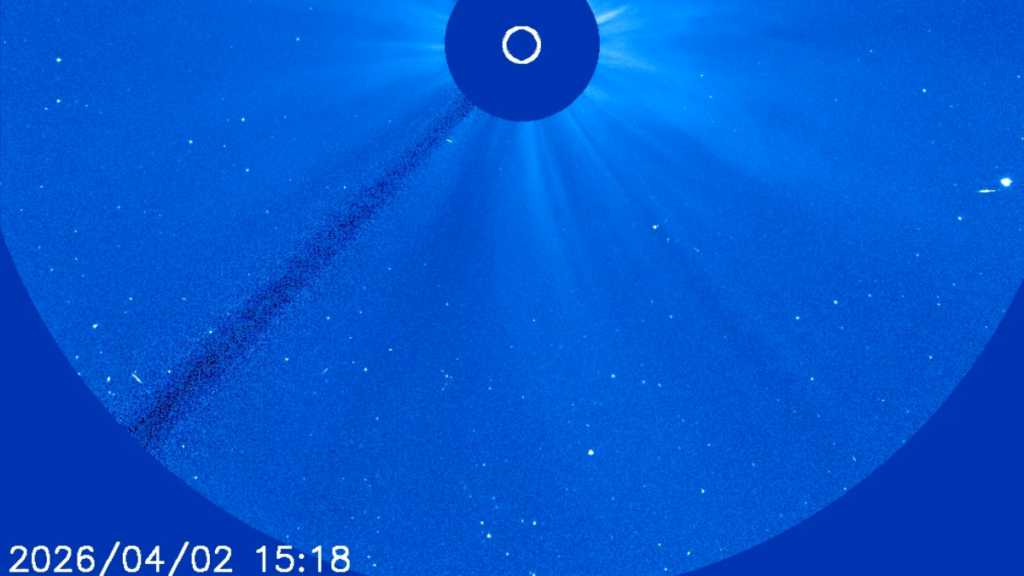
A newly discovered sungrazing comet, designated C/2026 A1, has met a fiery end after venturing too close to the Sun. First detected by the Solar and Heliospheric Observatory (SOHO), the comet was observed disintegrating as it passed within the Sun’s intense gravitational and thermal forces. Sungrazers, like C/2026 A1, are comets that approach the Sun at extremely close distances, often within a few solar radii. These objects are typically fragments of larger comets that have broken apart over time due to repeated solar encounters.
C/2026 A1 was likely a small, icy body with a fragile structure. As it neared the Sun, the extreme heat caused its nucleus to vaporize, while solar radiation pressure and tidal forces tore it apart. The disintegration of C/2026 A1 was captured by SOHO’s LASCO (Large Angle and Spectrometric Coronagraph) instrument, which specializes in observing the Sun’s outer atmosphere and detecting comets in its vicinity. Such observations provide valuable data for scientists studying the composition and behavior of these celestial objects.
Sungrazers are of particular interest to astronomers because they offer insights into the early solar system. Many are believed to originate from the Kreutz group, a family of comets thought to be remnants of a much larger comet that broke apart centuries ago. While C/2026 A1 did not survive its encounter, its brief appearance contributes to the ongoing study of these dynamic and often short-lived phenomena.
The SOHO mission, a joint project of NASA and the European Space Agency, has been instrumental in discovering thousands of comets, including many sungrazers. Its continuous monitoring of the Sun and its surroundings remains a critical tool for understanding solar system dynamics. As C/2026 A1 fades into memory, its disintegration serves as a reminder of the powerful forces at play in our solar system and the fleeting nature of these cosmic visitors.




Comments are closed for this story.