
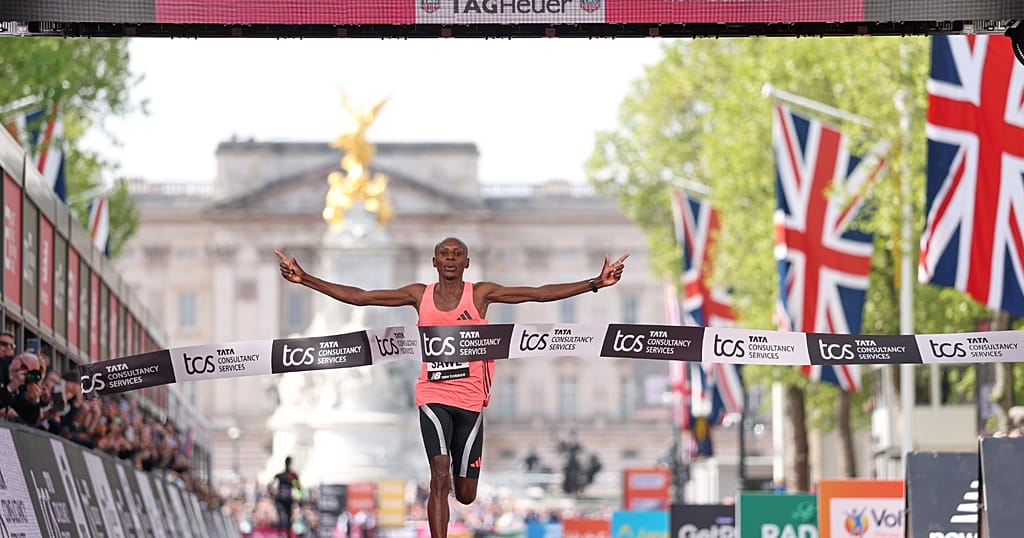
Sabastian Sawe of Kenya became the first athlete to run a marathon under two hours in an officially sanctioned race, finishing the London Marathon in 1 hour 59 minutes 30 seconds on Sunday. The performance broke the previous men’s world record by 65 seconds.
Sawe’s achievement was accompanied by a historic showing from the rest of the elite field. Yomif Kejelcha of Ethiopia, making his marathon debut, crossed the finish line in 1 hour 59 minutes 41 seconds, also under the two‑hour mark. Jacob Kiplimo of Uganda placed third with a time of 2 hours 00 minutes 28 seconds, improving the former world record of 2 hours 00 minutes 35 seconds set by Kenya’s Kelvin Kiptum in Chicago 2023.
The 29‑year‑old Sawe, who retained his London title, thanked the crowds that lined the streets of the capital. He noted that the spectators’ support contributed to his performance, saying, “If it was not for them you don’t feel like you are so loved… with them cheering you feel happy and strong.” Sawe accelerated in the second half of the race, covering the final 21.1 km in 59 minutes 1 second, and pulled away from Kejelcha after 30 km. He completed the last two kilometers alone, sprinting along The Mall to a roar of applause.
While sub‑two‑hour marathon attempts have been made in non‑record‑eligible settings, Sawe’s time is the first to meet all IAAF criteria. In 2019, Eliud Kipchoge broke the barrier in Vienna during the “1.59 Challenge,” a specially designed event featuring a short loop course, rotating pacemakers and pacing vehicles. That run, although timed at 1 hour 59 minutes 40 seconds, was not recognized as a world record. Sawe’s performance therefore sets a new benchmark for official competition.
Former London Marathon winner Paula Radcliffe remarked that the achievement redefines the sport’s standards. For context, the men’s marathon world record stood at 2 hours 01 minutes 39 seconds before Sawe’s run, and the overall best time in 1999 was 2 hours 05 minutes 42 seconds, set by Khalid Khannouchi in Chicago. The record has been progressively lowered over the past two decades by Kenyan and Ethiopian athletes, including Haile Gebrselassie, Wilson Kipsang, Kipchoge and Kiptum.
The women’s race also produced a record. Ethiopia’s Tigst Assefa defended her title with a time of 2 hours 15 minutes 41 seconds, the fastest ever in a women‑only marathon, though 16 seconds slower than Paula Radcliffe’s mixed‑race record of 2 hours 15 minutes 25 seconds set in 2003. In the wheelchair division, Switzerland achieved a double victory as Marcel Hug claimed his sixth consecutive men’s title and Catherine Debrunner retained the women’s title, edging out Tatyana McFadden.
Sawe’s sub‑two‑hour marathon in a fully sanctioned event marks a pivotal moment for long‑distance running, establishing a new performance standard that athletes worldwide will now aim to match.

Comments are closed for this story.