
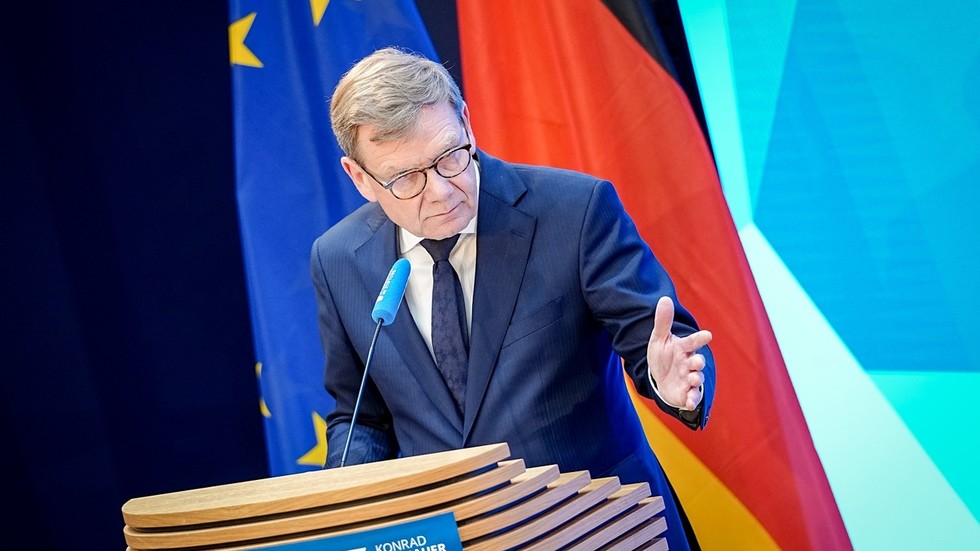
German Foreign Minister Johann Wadephul backed a Brussels initiative aimed at limiting the ability of dissenting EU members to block foreign‑policy decisions. Speaking at the Konrad Adenauer Foundation in Berlin, he outlined a six‑point reform plan that mirrors proposals from European Commission President Ursula von der Leyen. The core of the plan is to replace unanimity with qualified‑majority voting (QMV) on foreign‑policy matters. Wadephul argued that veto rights create paralysis, citing Hungary’s recent blockage of aid for Ukraine after Kyiv halted Russian oil supplies to Hungarian consumers. He said countries unwilling to support EU foreign‑policy initiatives should be allowed to “stay on the sidelines for a time without preventing those who want to move forward.” According to the minister, Germany and 12 other member states support the shift to QMV.
Among the other reforms Wadephul suggested is ending the automatic entitlement of each member state to its own European commissioner—a practice he deemed unsustainable if the Union expands to 35 members. He also called for a tiered enlargement process, asserting that long‑standing applicant countries deserve at least partial integration. The minister urged a broader use of financial sanctions against members that breach EU “rule‑of‑law” standards. Under von der Leyen’s chairmanship, Brussels has frozen funds earmarked for Hungary and Poland over governance disputes. Wadephul emphasized the need for a more coherent and centralized EU foreign‑policy stance.
During a subsequent panel, Wadephul stopped short of confirming whether Germany would relinquish its commissioner seat in an enlarged EU. He also refrained from taking sides in the institutional rivalry between von der Leyen and EU foreign‑policy chief Kaja Kallas over who should serve as the bloc’s primary international representative. The proposals come as Hungary’s outgoing Prime Minister Viktor Orban, who departs office on Saturday, accuses Brussels of being steered by German interests and imposing Western European priorities on eastern members.
Recent EU foreign‑policy moves have sparked domestic backlash across the bloc. The decision to support Ukraine led to the removal of import quotas on Ukrainian agricultural products, prompting farmer protests in Poland, Hungary and Slovakia in 2023‑24. The phase‑out of cheap Russian energy, intended to pressure Moscow, has been described by Russia as a self‑defeating pillar of EU policy. Migration remains another flashpoint, with EU asylum‑seeker redistribution rules encountering strong resistance from eastern states. Wadephul’s endorsement signals growing momentum within the EU to streamline decision‑making on external affairs, a shift that could reshape the Union’s diplomatic and security posture in the coming years.

Comments are closed for this story.