
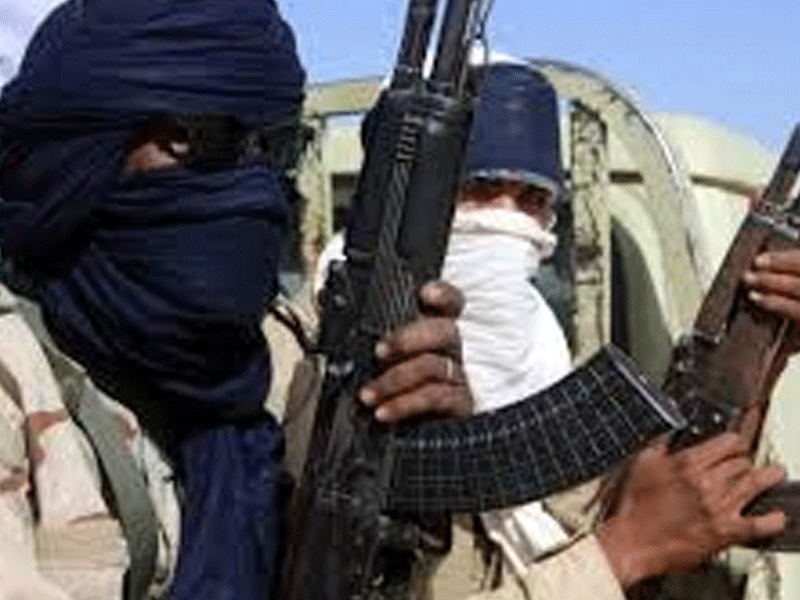
The video was almost unbearable to watch. Exhausted children, their faces blank with trauma, sat in a dusty room somewhere in Oyo State. They had just been abducted from their schools, and the footage, which spread like wildfire across social media, showed them broken, confused, and terrified. Parents across Nigeria stared at their screens in horror. Politicians panicked. The nation held its breath.
But here is the uncomfortable truth: the emotional shock of that video traveled faster than the facts. And that is exactly what the terrorists wanted.
Iyobosa Uwugiaren, in a hard-hitting analysis, argues that Nigeria is not just fighting a physical war against bandits and kidnappers. It is fighting a war for the mind. Terrorist groups, he says, thrive on visibility, publicity, and fear. Every time society exaggerates their power, their psychological influence expands. Communities become more intimidated. Victims feel more isolated. Citizens lose faith in institutions. And security personnel become demoralized.
The kidnapping in Oyo State was a stark reminder of this reality. Armed men stormed schools in Oriire Local Government Area, abducting dozens of pupils and teachers, including very young children. One teacher was killed. The attack revived painful memories of Chibok, Kankara, Afaka, Kuriga, and other mass abductions that have scarred the nation. In each case, the criminals understood a dark truth: schools are symbolic targets. Children represent innocence and the future. Attacking them generates maximum emotional reaction. The psychological effect often outweighs the operational scale of the attack itself.
This is how terror works globally. Violent groups understand media psychology. A single attack, amplified through videos, shouting headlines, and social media panic, can create the impression that the entire nation is collapsing—even when security agencies retain control in many areas.
The danger, however, is that Nigerians sometimes unknowingly assist in spreading this fear. Social media has turned insecurity into a real-time emotional spectacle. Videos circulate before verification. Old footage is reposted as fresh attacks. Rumors spread like wildfire. In the Oyo case, fact-checkers later revealed that one widely circulated torture video was old and unrelated. But by the time corrections emerged, the panic had already spread. That is precisely how psychological warfare succeeds.
Bandits and terrorists do not need to physically occupy cities. They only need citizens to believe nowhere is safe. Once fear dominates public consciousness, economic activities slow down, schools close, investors retreat, ethnic suspicions rise, and confidence in state institutions collapses. That is the strategic goal.
None of this means insecurity should be downplayed. The crisis is real, painful, and deadly. Thousands have been killed or displaced. Rural communities have been devastated. Farmers have abandoned their lands. Families live under constant anxiety. These are realities demanding urgent national attention.
But acknowledging the severity of insecurity is different from surrendering mentally to criminal propaganda. A nation can fight insecurity aggressively without amplifying hopelessness. Unfortunately, parts of Nigeria’s information ecosystem sometimes unintentionally glorify violent actors. Criminal leaders become household names. Their threats dominate headlines. Graphic videos get endless circulation. Public discourse begins to portray criminals as more powerful than the state itself. That is dangerous.
This is why responsible communication is now a national security issue. Nigeria’s Chief of Defence Staff, General Christopher Musa, has repeatedly urged journalists to exercise patriotism and professionalism in reporting security challenges. He warns that sensational or unverified reports can amplify criminal influence, undermine public confidence, and demoralize troops. There is a major difference between informing the public and amplifying terror. Graphic content and emotional manipulation may attract attention, but they also deepen collective trauma.
Media organizations need stronger ethical frameworks for reporting insecurity in the digital age. At the same time, the government must improve its own communication credibility. One major reason rumors dominate public discourse is that official communication is often slow, inconsistent, or dismissive. Citizens turn to unofficial sources when they do not trust government narratives. Strategic communication is not optional; it is essential. Security agencies must provide timely, transparent, and credible updates during crises. Silence creates information vacuums quickly filled by misinformation.
Citizens must also recognize the efforts of security agencies. The military, police, and local volunteers continue to operate under extremely difficult conditions. Many officers have lost their lives. Despite challenges, notable successes have been recorded: criminal camps dismantled, victims rescued, high-profile commanders neutralized. These efforts should not be ignored simply because insecurity still exists.
A dangerous national mindset emerges when citizens believe the state is entirely helpless. Such perceptions weaken morale among both civilians and security personnel. Nations confronting prolonged security crises require not only weapons and intelligence but also psychological resilience.
Nigeria’s insecurity problem is deeply connected to broader governance failures. Banditry thrives where poverty, unemployment, weak state presence, poor infrastructure, corruption, and social exclusion persist. Rural neglect has created environments where criminal groups recruit vulnerable youths. Military action alone cannot permanently solve the problem. Long-term stability requires comprehensive reforms: rural development, quality education, youth employment, intelligence coordination, border control, police reform, and stronger local governance.
Another troubling dimension is the politicization of insecurity. Political actors sometimes weaponize security crises for partisan advantage. While criticism of government is legitimate, exaggerated narratives designed to score political points can worsen national instability. Security challenges should never become tools for reckless political propaganda. The consequences affect everyone regardless of ethnic, religious, or political affiliation.
Perhaps most importantly, Nigeria must resist normalizing fear. One of the greatest victories terrorist groups can achieve is convincing citizens that insecurity is permanent, unstoppable, and inevitable. Once hopelessness becomes embedded in public consciousness, national cohesion begins to weaken dangerously.
History shows that societies survive security crises not only because of military strength but because citizens refuse psychological surrender. Nigeria has survived enormous challenges before: civil war, military dictatorship, economic crises, insurgencies, and communal conflicts. Despite these struggles, the country continues to demonstrate resilience.
The current wave of insecurity, though serious, is not beyond resolution. But defeating it requires balance. Government must avoid complacency while citizens avoid panic. Security agencies must intensify operations while improving professionalism. The media must inform without glorifying criminals. Citizens must remain vigilant without spreading misinformation. Political leaders must place national stability above partisan advantage.
Above all, citizens must understand that the battle against banditry is both physical and psychological. The guns may operate in forests and remote communities, but fear operates in the human mind. If terrorists succeed in controlling public imagination, they gain influence far beyond their actual capacity. But if Nigeria strengthens institutions, improves governance, supports security forces, promotes responsible communication, and refuses to surrender mentally to fear, then the psychological power of bandits can be broken.
The disturbing images from Oyo should awaken national urgency, not national despair. Nigeria must confront insecurity with courage, realism, intelligence, and resilience—without allowing criminals to define the country’s identity or future. That may ultimately become one of the most important battles the nation must win.




Comments are closed for this story.