
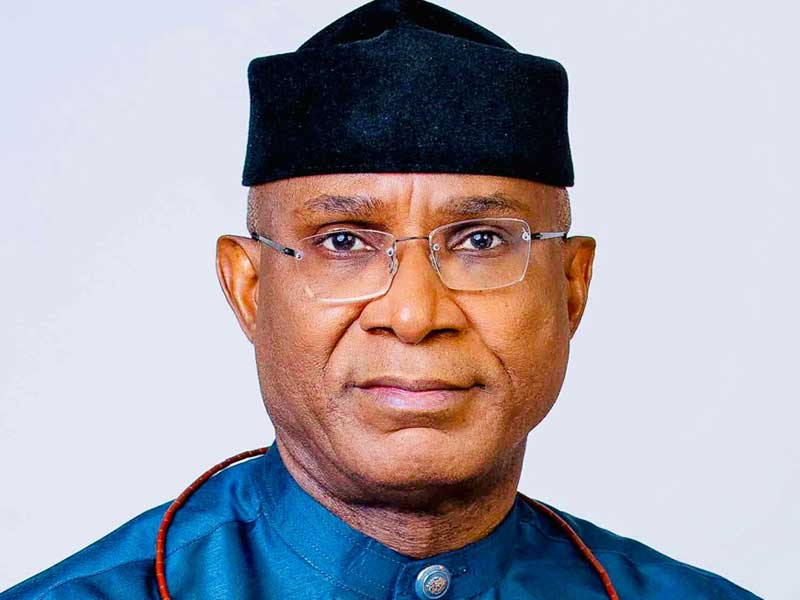
Former Deputy Senate President Ovie Omo-Agege fired back at Delta State Governor Sheriff Oborevwori on Tuesday, accusing him of flouting a direct order from President Bola Tinubu to merge old and new All Progressives Congress members under a 60-40 sharing formula after the governor defected to the party.
Speaking on Arise Television, Omo-Agege, who recently left the APC for the Nigeria Democratic Congress, declared his full support for Peter Obi’s 2027 presidential bid. He insisted his exit from the ruling party was not voluntary, alleging that Oborevwori’s leadership systematically sidelined long-standing APC members who campaigned for Tinubu’s 2023 victory.
“There was a directive from Mr. President, the leader of the APC, that there should be a 60-40 sharing arrangement between the old APC and the new intakes,” Omo-Agege said. “While that arrangement was implemented in almost every state, in Delta State Sheriff Oborevwori and his crew decided they were not going to do that.”
He claimed the governor’s camp seized full control of the party structure upon joining APC, displacing members who had worked for the party before the defection. “They came in and basically wiped out everyone. These are people who fought to give the president the votes he got in Delta in 2023, despite the opposition mounted by Sheriff Oborevwori and others,” he added. “They took the administrative structure of the party, but the people remained with me.”
Omo-Agege argued that his grassroots support remains strong across the state, and that Oborevwori’s decision to leave the Peoples Democratic Party for APC was driven by fear of facing him in another gubernatorial race. “If Sheriff believed I was not a threat, why didn’t he remain in the PDP and face me in 2027? The fact that he moved tells its own story,” he said.
The former deputy senate president alleged he won the APC governorship primary but was denied victory through manipulation by forces loyal to the governor. He claimed his supporters secured victory in 84 of 85 wards, amassing over 109,000 votes. “We won massively in every ward except the governor’s ward. We had about 109,000 votes,” he stated. “But unlike a general election where INEC provides safeguards, party primaries are conducted by panels appointed by the party. The panel was not allowed to conduct a free and fair process, and our votes were not properly recorded.”
Now a member of the NDC, Omo-Agege endorsed Peter Obi as his presidential candidate for 2027. “Of course, Peter Obi is my presidential candidate in 2027. I am now a member of the NDC and wherever I belong, my loyalty is total,” he said. “When I was in the APC, I supported President Muhammadu Buhari and later President Bola Tinubu 100 per cent. Now that I am in the NDC, my loyalty is to the party and to Peter Obi.”
He dismissed criticism that his party switch contradicted his earlier support for Tinubu’s economic reforms, noting that many policies, including fuel subsidy removal and exchange-rate reforms, were also backed by Obi. “The policies are not bad policies. I supported them under President Tinubu and I still support them. Peter Obi also supported many of those reforms,” he said. “I simply believe that under a different platform, they can be implemented in a way that inspires greater confidence among Nigerians.”
Omo-Agege also declared victory in the NDC senatorial primary for Delta Central, saying, “We have done the primaries and I won. There is absolutely no contention as to who won the Delta Central senatorial primary. I have been advised to allow the party to formally announce the result.”
He accused Oborevwori’s supporters of spreading misinformation on social media, calling them “e-rats,” and launched a blistering attack on the governor’s administration, alleging failure to translate increased revenues into meaningful development. Despite trillions of naira in federal allocations and internally generated revenues over three years, he said the state has little to show in terms of transformative projects and social infrastructure, with residents grappling with poverty, inadequate healthcare, poor education, and insecurity.




Comments are closed for this story.