
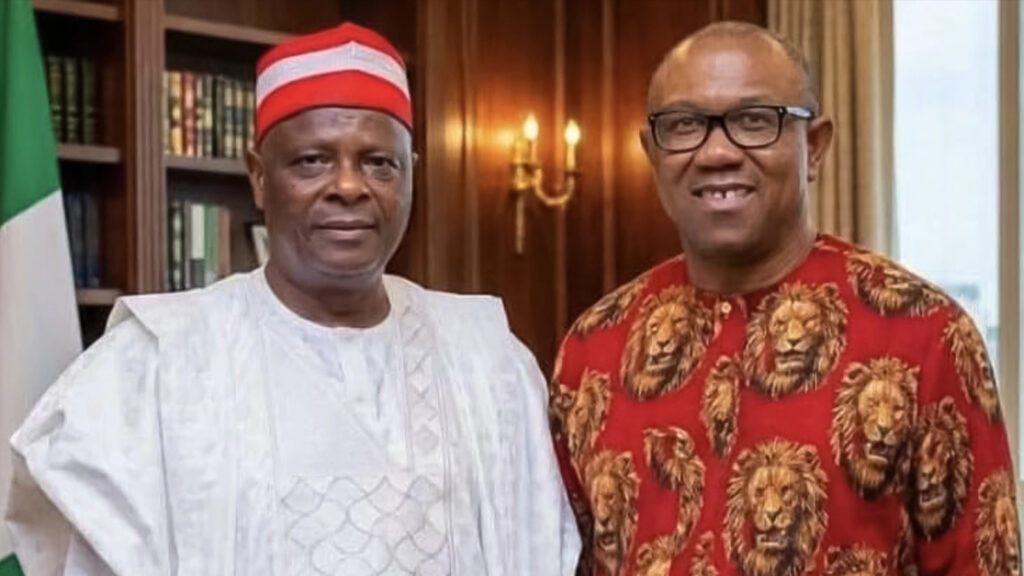
The political landscape in Nigeria’s Northwest has been thrown into flux following the surprise defection of Peter Obi and Rabiu Kwankwaso from the African Democratic Congress to the Nigeria Democratic Congress last month. This move, shaking the foundations of what was once an unchallenged All Progressives Congress stronghold, has sent ripples through the opposition’s grand strategy for the 2027 presidential race.
The region, a bedrock of APC support since 2015, now faces a fractured opposition. The initial plan, forged in April at the so-called “Ibadan Declaration,” aimed to unite key figures like Atiku Abubakar, Obi, Kwankwaso, Rotimi Amaechi, and Aminu Tambuwal against President Bola Tinubu. But that coalition crumbled within weeks, undone by clashing ambitions, deep-seated mistrust, and legal quagmires within the ADC.
Obi and Kwankwaso, seeking a platform free from infighting, landed at the NDC, where founder Seriake Dickson handed them the party’s presidential ticket. This realignment, according to Kamilu Fagge, a political science professor at Bayero University, Kano, is a devastating blow to the ADC and the broader opposition, especially in the Northwest.
Fagge warns that Nigeria may be headed for a repeat of the 2023 scenario, where three major candidates split the opposition vote, handing an advantage to the incumbent. He notes that while Obi draws massive support from the Southeast and Christian communities in the North-central, Kwankwaso’s influence is largely confined to Kano. “Most of Kwankwaso’s votes are concentrated in Kano,” Fagge explains. “He can’t pull a strong showing in neighboring states like Jigawa, Katsina, or Kaduna. In states where he lacks popularity, the ADC is poised to gain.”
Kwankwaso’s traditional youth base in Kano is now fractured, Fagge argues. Governor Abba Yusuf, once a Kwankwaso protégé, has forged an alliance with former APC National Chairman Abdullahi Ganduje and Deputy Senate President Barau Jibrin, creating a formidable new force that will siphon votes from Kwankwaso’s old machine. Under the NDC, Kwankwaso might still perform decently in Kano, but it won’t match his 2023 showing under the NNPP, when various forces unified behind him. Now, he faces a host of new adversaries.
The Northwest’s political future, Fagge believes, will see votes split in three or four directions, making it nearly impossible for the opposition to unseat the APC. He sees Atiku Abubakar as the best hope to consolidate the northern vote, improving his numbers in the Northeast, Northwest, and parts of the North-central.
Ibrahim Siraj, a political analyst at Bayero University, notes that the seven Northwest states have been an APC stronghold since the party’s formation, largely due to the enduring influence of the late former President Muhammadu Buhari. In 2023, both Obi’s Labour Party and Kwankwaso’s NNPP performed poorly in the region, despite Kwankwaso’s dominance in Kano. “This dynamic is unlikely to change soon,” Siraj says. “Voters still lack faith in either Obi or Kwankwaso, individually or collectively.”
Yet, Siraj cautions that support for President Tinubu is not guaranteed. The people of the Northwest are bearing the brunt of harsh economic policies—reforms the president calls necessary but have yet to improve ordinary lives. The Obi-Kwankwaso alliance could theoretically shake up the race, but Siraj suggests it might ultimately favor Tinubu. The true test, he stresses, will be a free and fair electoral process.
“President Tinubu stands to benefit from the APC’s formidable structure in the region, controlling almost all state governments and holding the majority of NASS seats,” Siraj explains. “Add to that a divided opposition, and Atiku may do well, but a united house is the only path to success.”
Kwankwaso remains a force in Kano politics, but replicating his 2023 showing will be an uphill battle. A central challenge is his political rift with Governor Yusuf, who has decamped to the APC, taking many of Kwankwaso’s grassroots operatives—commissioners, advisers, and local government chairmen—with him. “Those people will not be available to work for Kwankwaso again,” Siraj says.
Beyond internal defections, Kwankwaso faces a unified opposition engineered by his former ally. Yusuf has rallied major political players across the state against his former mentor. Geopolitical dynamics within Kano are also shifting, with Kwankwaso’s influence now limited to his traditional stronghold of Kano Central, while losing ground in Kano North and Kano South.
The stage is set for a high-stakes political battle in the Northwest, with the opposition’s hopes hanging by a thread.

Comments are closed for this story.