
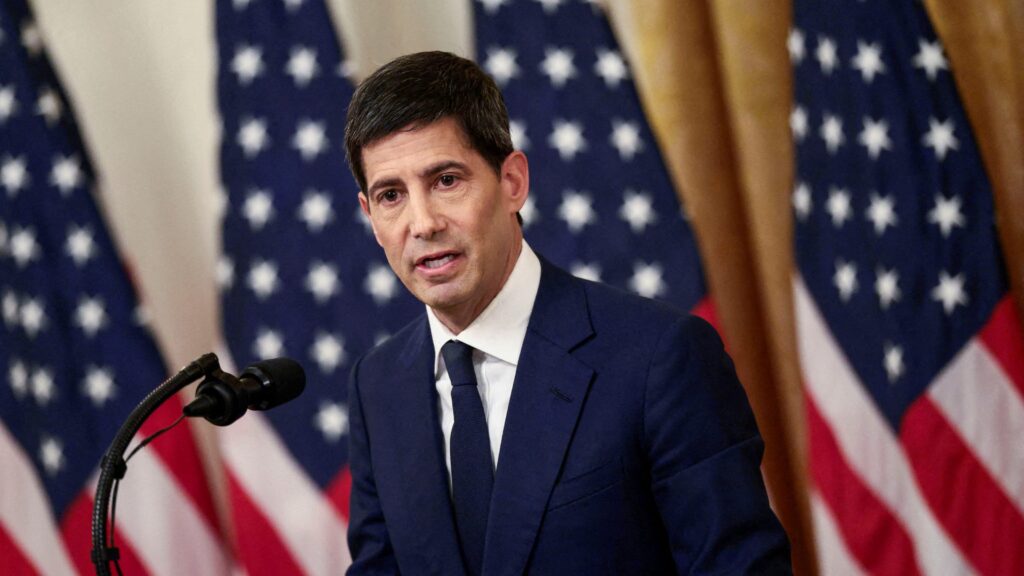
The Federal Reserve kept its key interest rate unchanged on June 17, marking Kevin Warsh’s debut as chair under President Donald Trump. The decision came despite the president’s repeated calls for lower borrowing costs.
The federal funds rate, a benchmark for loans across the economy, stays at 3.5% to 3.75%. The Fed’s quarterly Summary of Economic Projections revealed a divided committee: only 18 of 19 members submitted their 2026 rate forecasts. Among them, eight expect rates to hold steady, nine see room for hikes, and one predicts a cut later this year.
“Economic activity is expanding at a solid pace despite elevated uncertainty, partly due to the conflict in the Middle East,” the Fed said in a statement. It noted solid job gains and persistent inflation, adding, “The Committee will deliver price stability.” The vote was unanimous among the 12 voting members of the Federal Open Market Committee.
All eyes are on Warsh’s 2:30 p.m. press conference. He’s expected to offer less forward guidance than usual but may reveal his view on the biggest challenge facing the U.S. economy after three months of strong job growth and rising prices.
Stocks traded cautiously ahead of the decision. The Nasdaq and S&P 500 were flat, while the Dow rose 116 points, or 0.2%. The Russell 2000, tracking small-cap stocks, climbed 1.3%. Brent crude oil slipped to $79.13 a barrel, down from $80, while the U.S. 10-year Treasury yield edged lower to 4.435%.
Warsh, a former Fed governor, takes the helm at a time of division among policymakers. In April, four of 12 voting members dissented from the decision to hold rates steady. Now-former Governor Stephen Miran favored a quarter-point cut, while Beth Hammack, Neel Kashkari, and Lorie Logan supported the hold but objected to language hinting at future cuts. A June 16 Bank of America report predicts no dissents today.
Bond investors remain skeptical about inflation, even as oil and gas prices have fallen since the weekend U.S.-Iran ceasefire. Yields have barely budged. “The bond market needs more convincing that inflation isn’t going to be embedded in the economy,” said John Mousseau of Cumberland Advisors.
Higher yields have big implications. The 10-year yield influences the 30-year fixed-rate mortgage, which over 90% of borrowers use. It also raises the cost of government debt, ultimately paid by taxpayers. Bond investors sell when they expect inflation, pushing yields up and making borrowing more expensive.
Inflation has surged since the Iran conflict began, driven by energy costs. The Consumer Price Index rose 4.2% in May, a three-year high, while the Fed’s preferred PCE index climbed 3.8% in April—both well above the 2% target. But hopes for a peace deal by week’s end have pushed oil to a three-month low, giving policymakers reason to wait.
Consumer sentiment ticked up in June after hitting an all-time low in April. The University of Michigan’s index rose 9.2% to 48.9, still 13% below January 2026 levels. Director Joanne Hsu attributed the bump to relief at the gas pump, where the national average fell to $4.03 from $4.51 a month ago.
Warsh, known as a hawk during his 2006-2011 tenure for favoring higher rates to tame inflation, has recently sounded more dovish. He argued as a nominee that AI-driven productivity gains and a smaller Fed balance sheet could lower prices, leaving room for cuts. But Darius Dale of 42 Macro said, “I don’t think anyone knows what Warsh’s true reaction function is.” Today’s vote and press conference may clarify.
The federal funds rate affects credit cards, personal loans, and mortgages. The Fed typically cuts rates to boost the labor market and raises them to fight inflation. Higher rates can also improve returns on savings accounts and CDs.
Longtime Fed-watcher Steve Blitz of GlobalData expects a shift: “I am expecting something that says there’s a new sheriff in town. Dropping the dot plot, doing something with the balance sheet. Otherwise it’s just a Powell FOMC with a newer younger suit giving the press conference.”
President Trump told NBC there was “no reason” for the Fed to raise rates, even after the Labor Department reported 172,000 new jobs and three-year-high inflation in May. But traders now expect a rate hike later this year, not a cut. A Duke University survey of former Fed officials suggests a narrow majority sees modest rate increases as necessary.
U.S. stock futures traded higher Wednesday morning. The S&P 500 rose 8 points, Dow futures were flat, and the Nasdaq looked set to open 200 points higher. Investors are also watching the U.S.-Iran conflict and SpaceX shares, which topped Amazon’s market cap in three days of trading.
The Fed cut rates three times last year, with the last reduction in December 2025, when job growth averaged only 15,000 per month. Hiring has since rebounded to over 100,000 per month in 2026.
Warsh may not submit his own dot plot forecast. If he does, Bank of America expects it to lean dovish. The FOMC meeting resumes at 9 a.m. ET, with the rate decision at 2 p.m. and Warsh’s press conference at 2:30 p.m.


Comments are closed for this story.