
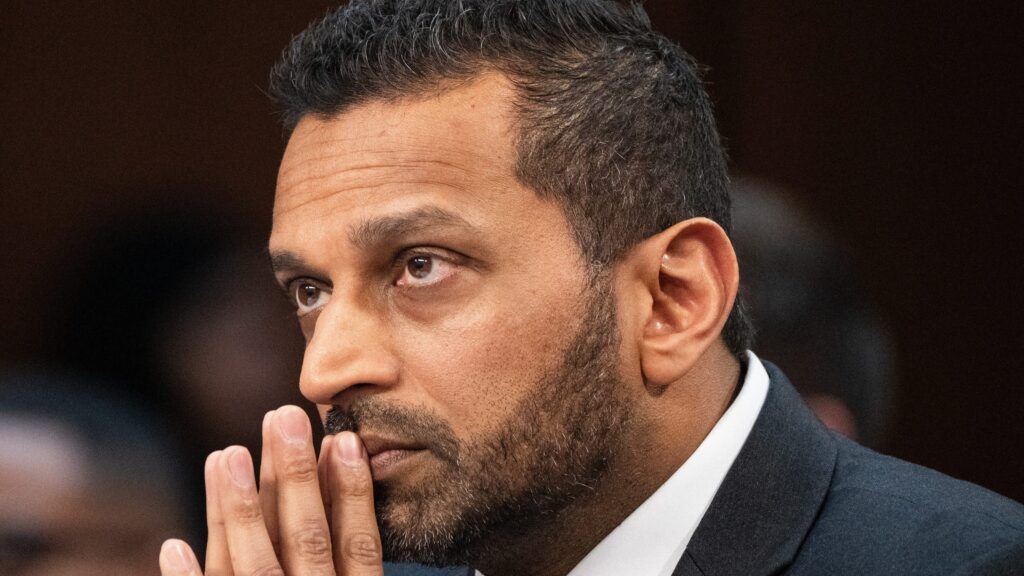
The Secret Service had a tight lid on an alleged plot to attack a UFC event at the White House, keeping the investigation under wraps to track down suspects still at large. Then FBI Director Kash Patel decided to spill the beans on social media, sparking frustration and accusations of jeopardizing the case.
Deputy Secret Service Director Matthew Quinn revealed on June 16 that the agency had intentionally kept the probe quiet. “It was an active plot, and it’s ongoing,” Quinn said. “There are still suspects at large, and we’re going to work it until everyone’s been identified.” But Patel’s early morning X post on June 16, claiming credit for foiling the threat, ended that secrecy.
The FBI “and our law enforcement partners” caught wind of the potential attack on the UFC America 250 event in Washington on June 10, Patel stated, adding that “multiple individuals are now in custody and the allegedly planned attacks were stopped cold.” However, a federal law enforcement official told USA TODAY that authorities were hunting at least 10 more people for questioning before Patel’s announcement turned the investigation into front-page news.
This isn’t the first time Patel’s public announcements have stirred controversy. Critics accuse him of leaking confidential investigative details that complicate active probes. His frequent X posts—he boasts 2 million followers—go far beyond the cautious approach of predecessors like James Comey and Christopher Wray. Notably, Patel prematurely claimed a breakthrough in the 2025 assassination of conservative influencer Charlie Kirk, only for authorities to release the suspect hours later. He’s also made inaccurate remarks about the disappearance of Nancy Guthrie and a shooting at a Dallas ICE facility, drawing pushback from other law enforcement agencies.
At a June 16 news conference, Quinn didn’t name Patel or the FBI directly but expressed clear frustration. “I’ll tell you a phrase I learned early in my career in the New York field office, and that’s ‘Don’t choke on your own smoke,’” Quinn said. “Anyone that believes that case was worked in a bubble (by the FBI) is naive. I’ll tell you, the Secret Service led that investigation from the beginning.”
The investigation, filed under seal to prevent leaks, involved at least five charged suspects: Tycen Proper, Abraham Hermosillo Alvarez, Bryan Omar Roa, Michael Alan Thomas, and Daniel K. Eskridge, hailing from states like Missouri, Ohio, and California. Court documents allege a sprawling plan to attack the June 14 event attended by President Donald Trump, Vice President JD Vance, Secretary of State Marco Rubio, Pentagon chief Pete Hegseth, and Patel himself. The plot included using drones and snipers on the White House’s South Lawn.
The Secret Service and FBI first learned of the threat when a suspect’s relative contacted Ohio police. The Secret Service’s Advanced Threat Interdiction Unit (ATIU) identified a Signal chat used by the plotters, uncovering their communications. Quinn emphasized the ongoing nature of the case: “In order to maintain the integrity of the investigation and the security plan, we chose not to leak it. It was a serious threat.”
Late on June 16, the FBI issued a joint statement with the Secret Service, praising their partnership: “This investigation highlights that continuous partnership and could not have happened without the great work and coordination between our two agencies.”
Democrats in Congress have slammed Patel’s social media habits. Sen. Dick Durbin, D-Ill., recalled Patel’s Kirk case misstep: “Mr. Patel was so anxious to take credit for finding Mr. Kirk’s assassin that he violated one of the basics of effective law enforcement: at critical stages of an investigation, shut up and let the professionals do their job.”


Comments are closed for this story.