
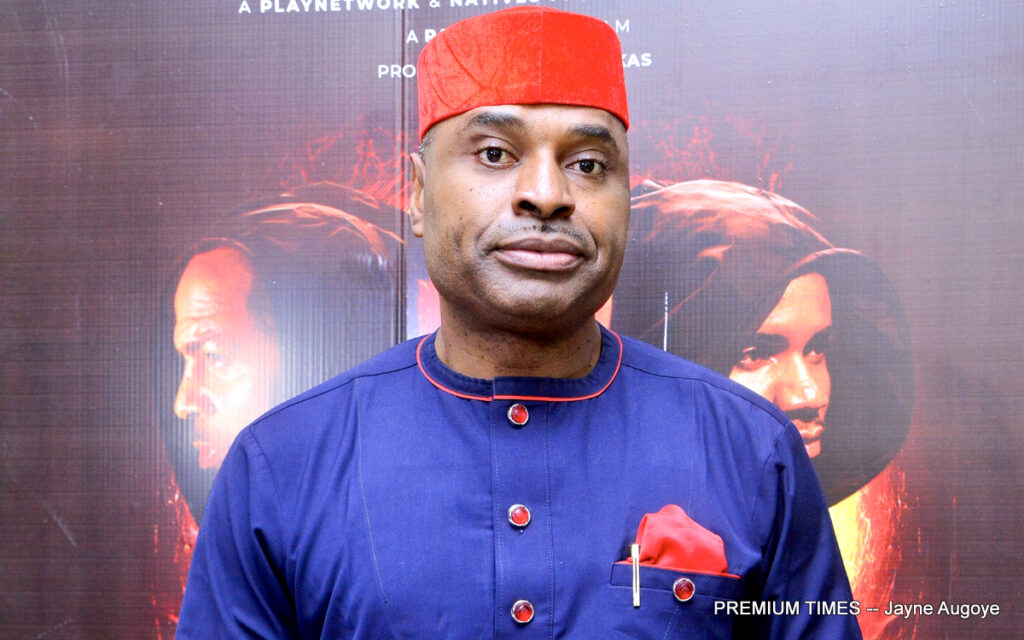
In Greek myth, Pygmalion carved a statue so perfect he fell in love with it. The gods brought it to life. Today, veteran Nollywood actor Kenneth Okonkwo seems intent on bringing his most famous character to life too—not on screen, but in Nigerian politics.
Many younger Nigerians may not remember that before Netflix and Prime Video, there was Living in Bondage. Released in 1992 and 1993, it is widely considered the foundation of modern Nollywood. Kenneth Okonkwo played Andy Okeke, a struggling businessman who joins a secret cult and sacrifices his wife for wealth. He gets rich, but guilt and destruction follow.
That role made Okonkwo a household name. But now, his political journey mirrors Andy Okeke’s tragic arc. He has supported Goodluck Jonathan’s PDP, campaigned for Muhammadu Buhari’s APC, become a passionate advocate for Peter Obi in the Labour Party, and then turned against Obi while aligning with Atiku Abubakar in the ADC. Each shift comes with bitter personal attacks on former allies.
The problem is not party-hopping. In Nigeria, that is common. The problem is Okonkwo’s tendency to turn every disagreement into a war. Yesterday’s heroes become today’s villains. Bridges are burned with the same enthusiasm they were built.
Politics is not war. It requires patience, restraint, and the ability to disagree without destroying relationships. The greatest politicians understand that today’s opponent may be tomorrow’s ally. Instead, Okonkwo seems to model himself after the mercenary politics of figures like Reno Omokri and Femi Fani-Kayode.
For a man desperate to be seen as a political heavyweight, his conduct betrays impatience bordering on desperation. He uses grandiose language to project gravitas, but true statesmanship is earned through consistency, humility, and the discipline to build patiently.
Andy Okeke sought wealth without patience and paid a terrible price. Kenneth Okonkwo, in his political journey, appears equally impatient for relevance. One can only hope that, unlike his famous character, he recognizes the danger before the final act is written.
The greatest tragedy would be for the actor who warned a generation about the perils of ambition without principle to become the living embodiment of that lesson.




Comments are closed for this story.