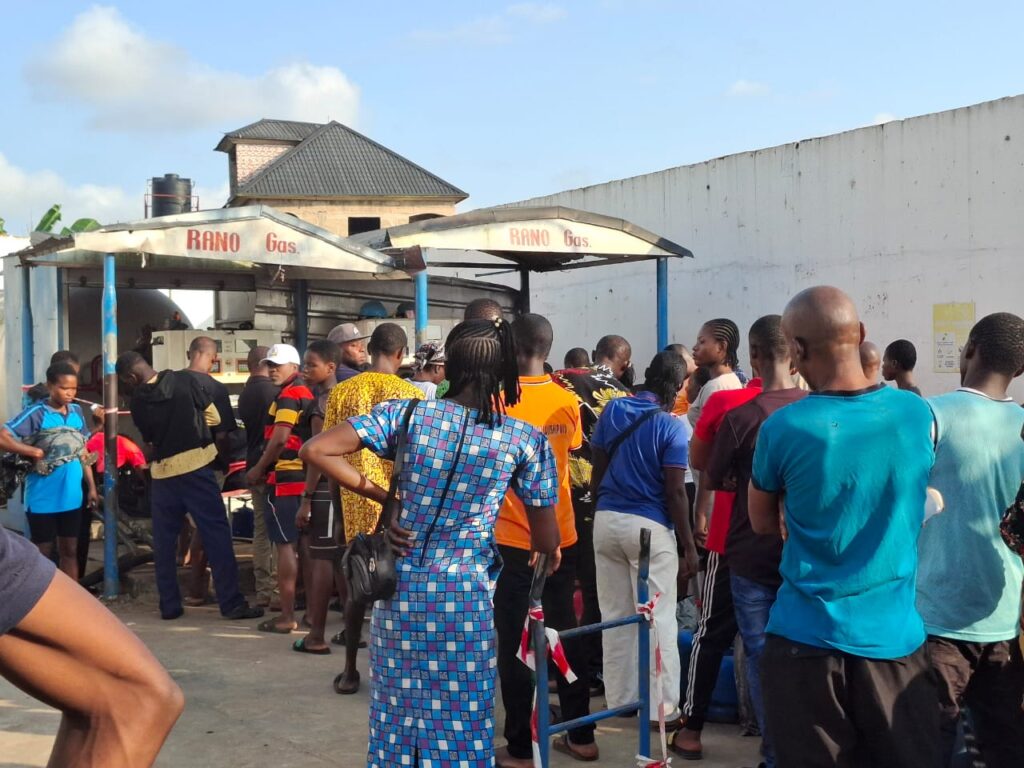
Lolade Fayemi, a fashion designer in Lagos, walked into a gas refill station in Baruwa, Iyana-Ipaja, in June with her 6kg cylinder and a plan to buy just 2kg of cooking gas. What she found shocked her. The price had shot up from about 1,700 naira per kilogramme to 2,500 naira within a week. She could only afford one kilogramme. “The price is ridiculous,” she said. “You still spend money on transportation to the gas station, and the gas may not even serve you for a week.”
Fayemi’s story is not unique. It reflects the experience of millions of Nigerians as the price of Liquefied Petroleum Gas, or cooking gas, surged following supply disruptions linked to tensions involving Iran, the United States and Israel. Energy experts say the crisis is not just about global events. It is also about Nigeria’s own failures: inadequate infrastructure, inconsistent government policies, and a heavy reliance on imported LPG.
A nationwide survey by PREMIUM TIMES across Nigeria’s six geopolitical zones found that LPG prices rose from about 1,100 to 1,350 naira per kilogramme in April and May to between 1,700 and 2,200 naira in late June. Some outlets charged as much as 2,500 naira. By early July, prices had eased to between 1,250 and 1,800 naira, but many households are still buying smaller quantities, postponing refills, or returning to traditional cooking methods like firewood and charcoal.
In Lagos, retailers blamed the spike on shortages at coastal depots and uncertainty in international energy markets. Lateef Badmus, manager of Al-Moruff Gas Plant, said retail prices simply reflect wholesale costs. “When there is scarcity and demand is high, prices increase because consumers have little choice,” he said. Damilola Adeyoriju, administrator at Casco Gas, described the period as a “man-know-man” market, where access to supplies depended on personal relationships. “The few marketers that had products sold mainly to people they knew,” she said.
The impact on families is severe. Enomfon Okure, an oncology nurse, said she paid 2,100 naira per kilogramme in June compared to about 1,700 naira in May. “The hike affects everything because cooking gas is our only reliable means of cooking,” she said. Another resident, Ajura Oseme, said the increase forced her to temporarily return to charcoal. In rural communities across Ondo State, households have reverted to firewood and charcoal, while some urban residents with stable electricity are increasingly using electric cookers.
The crisis is also hitting small businesses hard. Victoria Okechi, who runs a food business in Osogbo, said the increase forced her to raise food prices to stay afloat. She welcomed the recent reduction but warned that another spike would leave many small businesses with little choice but to raise prices again. In Plateau State, Albarka Danladi, a small business owner, said soaring cooking gas prices forced him to shut down the food section of his business.
Industry operators say the recurring price shocks stem from a combination of global market disruptions and domestic structural weaknesses. Segun Adigun, Executive Director of Thruvision Gas Plant in Abuja, said policy inconsistencies, inadequate infrastructure, and dependence on imported LPG continue to expose consumers to price volatility. He explained that for years, producers exported most of Nigeria’s LPG because contracts signed before domestic demand expanded did not prioritize local supply.
The federal government has announced emergency measures to address the crisis, including directing regulatory and security agencies to crack down on diversion, hoarding, and illegal storage of LPG. Minister of State for Petroleum Resources (Gas), Ekperikpe Ekpo, described the price surge as a national concern affecting households, small businesses, and the economy. The government has also directed the Nigerian Midstream and Downstream Petroleum Regulatory Authority to strengthen market oversight and establish a pricing framework.
Despite these efforts, industry stakeholders warn that lasting stability will depend on expanding domestic LPG production, strengthening storage and distribution infrastructure, and maintaining consistent market policies. Energy experts argue that until those structural challenges are addressed, Nigerian households will remain vulnerable to periodic cooking gas price shocks, driven as much by domestic bottlenecks as by events thousands of kilometres beyond the country’s borders.