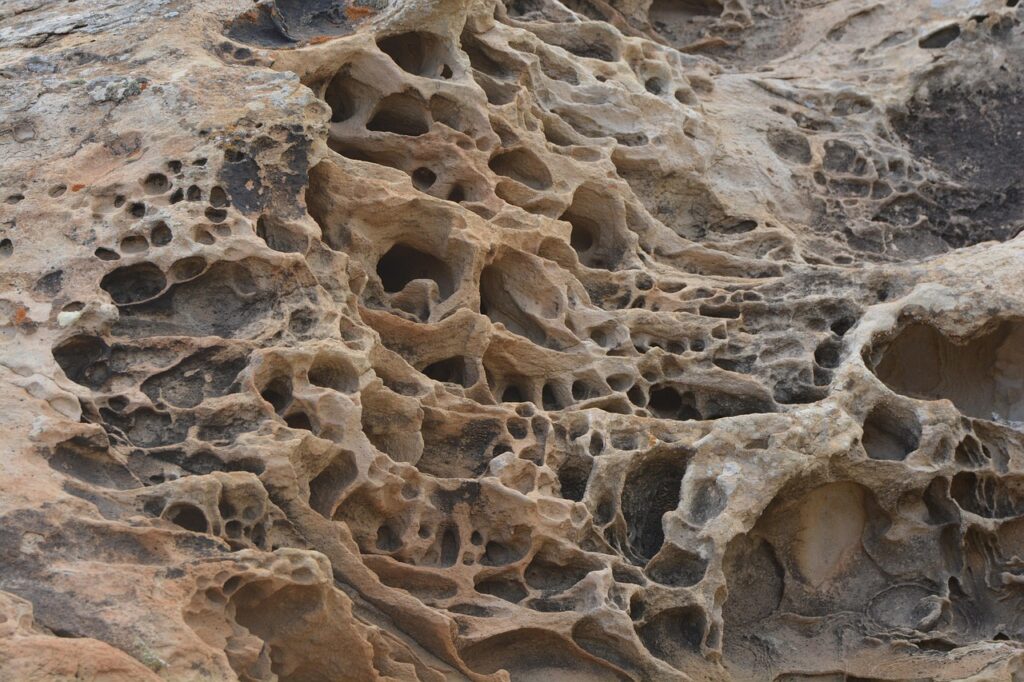
Most people see a rock and think of something static, lifeless, and utterly unremarkable. But to a petrologist, a chunk of granite or a slab of slate is a time capsule, a coded message from the planet’s fiery core to its shifting surface. This branch of geology is not just about hammering samples in the field; it is a forensic science dedicated to reconstructing the violent, slow, and spectacular events that built the world beneath our feet.
The discipline hinges on a simple yet profound truth: every rock has a biography. That biography begins in one of three distinct realms. Some are born of fire, when molten magma cools and crystallizes into igneous formations. Others are built from the debris of older mountains, layer by layer, through the patient accumulation of sediment that becomes sedimentary rock. And then there are the shapeshifters, the metamorphic rocks, which are forged under immense pressure and heat deep within the Earth, transforming their very atomic structure into something new.
The study of these fiery origins, known as igneous petrology, offers a direct line to the planet’s internal thermostat. By examining intrusive rocks like granite, which cooled slowly beneath the surface, or extrusive rocks like basalt, which erupted violently from volcanoes, scientists can trace the thermal currents of the mantle. These rocks are not just geological specimens; they are the frozen records of the Earth’s heat engine, explaining everything from continental drift to the formation of volcanic island chains.
Turning to sedimentary petrology, the focus shifts from the depths to the surface and the passage of time. These rocks are the planet’s archive of ancient environments. A single layer of sandstone can tell you whether it was once a desert dune, a riverbed, or a beach. The presence of organic matter or specific chemical signatures can reveal the composition of ancient oceans and the rise and fall of prehistoric ecosystems. It is a discipline that reads the Earth’s diary, one stratum at a time.
Then there is the world of metamorphic petrology, which deals with the ultimate makeover. When rocks are dragged deep into the crust during mountain-building events or subduction zones, they are subjected to conditions that would crush and cook ordinary matter. The result is a new rock, like marble or schist, whose mineral alignment and texture reveal the direction and magnitude of the tectonic forces that acted upon it. These rocks are the stress gauges of the planet, offering hard evidence of how continents collide and split apart.
To unlock these secrets, petrologists do not rely on the naked eye alone. They deploy an arsenal of high-tech tools, from optical microscopes that reveal the intricate interlocking of crystals to scanning electron microscopes and X-ray diffraction that identify minerals down to their atomic lattice. Geochemical analysis goes further, measuring the precise concentrations of trace elements and isotopes, which act as fingerprints for the rock’s origin and history.
This deep scientific curiosity has profound, practical consequences. The search for critical minerals, from copper to lithium, depends on understanding the magmatic and hydrothermal processes that concentrate these elements. In urban planning and construction, knowing the mechanical properties of bedrock is essential to prevent building collapses. And in hazard mitigation, petrology helps predict the behavior of unstable slopes, the likelihood of volcanic eruptions, and the potential for earthquakes along fault lines.
Petrology is far more than a dusty academic pursuit. It is the science of reading the planet’s memory. By deciphering the intricate history locked within a simple stone, we gain the knowledge to navigate our own future, from managing vital resources to protecting ourselves from the Earth’s most powerful natural forces.