Nigeria’s Solar Sector Grapples with Import Dependence as Government Pushes Domestic Manufacturing
By Oladehinde Oladipo
Solar power has emerged as a crucial lifeline in Nigeria, plugging electricity gaps that the national grid and diesel generators cannot fix. Yet, in a country where roughly 87 million people lack access to electricity, the panels keeping homes and businesses lit almost entirely come from abroad.
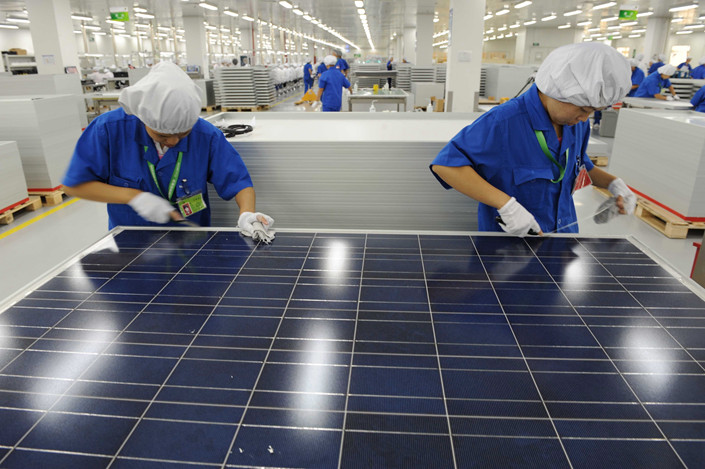
The country wants the jobs and industrial upside that come from manufacturing solar equipment domestically, but it cannot afford to slow down the imports currently sustaining the sector.
“Nearly all solar panels and accessories are imported,” David Terungwa, executive director of the Global Initiative for Food Security and Environmental Protection (GIFSEP), told a gathering of officials, financiers and researchers at an event in Nigeria’s commercial capital. He called the sector “an all-comers affair”, largely unregulated, and dependent on supply chains Nigeria doesn’t control.
The government’s answer is to try to become a manufacturer, not just a customer.
“Countries such as China, India and Vietnam have demonstrated that long-term prosperity comes from manufacturing clean energy technologies, not simply consuming them,” said Olamide Fagbuji, senior special assistant to President Bola Tinubu on climate technology and operations. Nigeria, he said, needs “deliberate industrial policy” to become “a producer, assembler and exporter of renewable energy technologies.”
Nigeria has floated import restrictions before, on other goods, to force local production loose from foreign suppliers. Some in the solar sector want the same treatment. Terungwa isn’t one of them, not yet.
“Are we ready for a solar ban now? No,” he said. “Banning solar imports now would be like removing lifelines in a crisis.” Move too early, before local manufacturing exists to fill the gap, he warned, and the result would be more energy poverty, not less.
Terungwa recommended incentives for local production, support for assembly plants, and cheaper financing for clean-energy systems, balancing “local manufacturing and energy access,” as he put it, instead of picking one over the other.
He pointed to lithium battery plants recently commissioned in Zamfara and Nasarawa states, and to early efforts by the National Agency for Science and Engineering Infrastructure to get domestic solar-panel production off the ground.
Daniel Awolaja, co-founder of the Africa Energy Tracker, which has logged more than 3,500 disclosed energy investment projects across the continent since roughly 2006, told the forum that Nigeria pulled in nearly $100 billion in energy investment over the past ten years, second on the continent only to South Africa, across 422 tracked projects.
The problem is where that money landed. About 92 percent of it went to oil and gas, Awolaja said, leaving renewables, grid infrastructure and storage to split what remained.
Generation capacity grew by roughly three gigawatts in 2025 alone, one of the strongest annual gains anywhere in Africa, but transmission and distribution investment hasn’t kept pace, so new power plants don’t reliably translate into power that reaches a home or a shop.
Nigeria currently has about 14 gigawatts of installed generation capacity, Awolaja’s research shows, but only around five gigawatts of it reaches the grid reliably.
He credited All On, an impact investment firm, with an early bet that reshaped the market: treating solar as a business proposition rather than a charity project or corporate goodwill exercise, a shift he said helped catalyse Nigeria’s current solar sector.
Awolaja noted Nigeria adopted mini-grid regulations and duty exemptions on imported solar equipment as far back as 2015, among the most comprehensive frameworks anywhere in Africa at the time, and passed climate legislation into law through an Act of Parliament, a step few African countries have matched.
He told a story of how a Nigerian energy expert travelled to Brazil to study its mini-grid rules, only to find Brazilian officials were still building systems Nigeria had already put on paper years before.
“Nigeria’s regulatory framework for mini-grids was significantly more advanced than their own,” Awolaja said the Brazilian officials told him, a framework Nigeria still hasn’t fully put to work at home.
The Electricity Act 2023, which handed states the power to set up their own electricity markets, has already helped unlock more than $1.3 billion in commitments for distributed renewable energy, channelled through programs including the Nigeria Electrification Project and the Distributed Access through Renewable Energy Scale-up program, according to Fagbuji.