Russian studies are often framed as a journey through literature, history, and the Cyrillic script. But peel back the layers, and you will find something unexpected: a discipline increasingly driven by numbers, algorithms, and the cold logic of statistical models. This is not the Russia of balalaikas and samovars, but a nation whose cultural DNA is being decoded through Markov chains and network theory.
The language itself is a starting point. With over 150 million native speakers, Russian is more than a means of communication—it is a linguistic puzzle wrapped in a 33-letter Cyrillic alphabet. That script, a legacy of Byzantine missionaries and the Orthodox Church, is not just an aesthetic curiosity. It shapes how Russians think, write, and express the nuances of time and action. The grammar, with its infamous cases and aspects, forces speakers to constantly choose between completion and continuity, a habit that seeps into the national psyche.
Nowhere is this more visible than in the pages of Tolstoy and Dostoevsky. Researchers have begun applying mathematical rigor to their prose, counting verb forms and mapping sentence structures with the precision of a physicist. A notable analysis of War and Peace found that Tolstoy’s heavy reliance on the imperfective aspect was no accident. It was a deliberate stylistic tool, one that creates a sense of endless motion, of life as a river that never quite stops flowing. Dostoevsky, by contrast, leans into the perfective, snapping his verbs shut like doors to emphasize moments of crisis and finality.
But the mathematics does not stop at grammar. Using network theory, scholars have transformed the sprawling cast of characters in Russian novels into intricate webs of social connections. The results are startling: the relationships in Anna Karenina mirror the hierarchies of imperial Russia, while the tangled loyalties in The Brothers Karamazov resemble a system on the verge of collapse. These maps do not replace literary interpretation; they enrich it, offering a bird’s-eye view of the structures that drive the stories.
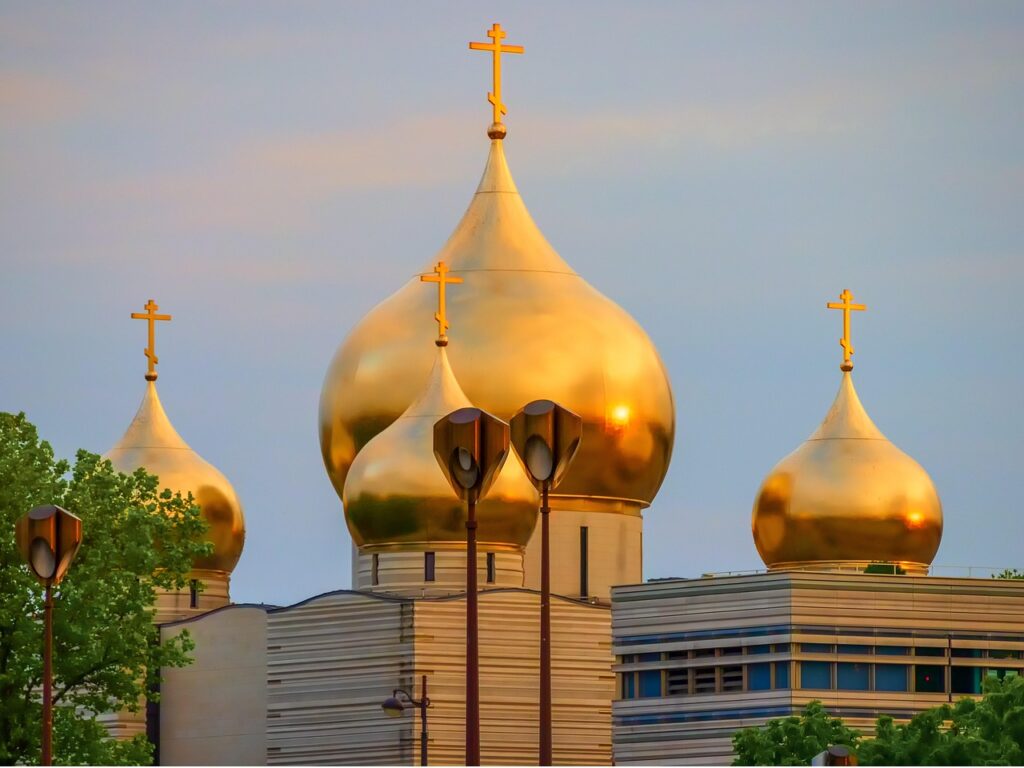
Beyond the page, Russia’s geographical position between Europe and Asia has produced a culture of deliberate contradictions. The onion domes of St. Basil’s Cathedral speak of Byzantine piety, while the brutal concrete blocks of Soviet housing projects shout the ambitions of a secular empire. This architectural dialogue is a reflection of a nation perpetually torn between East and West, between tradition and revolution. The same tension runs through Russian music and art, from Tchaikovsky’s European polish to the raw, Asiatic melancholy of Mussorgsky.
Symbols, too, carry the weight of this duality. The double-headed eagle, staring both east and west, is not just a heraldic relic. It is a semiotic statement of Russia’s self-image as a bridge, or perhaps a battleground, between civilizations. The hammer and sickle, meanwhile, was a modern invention that sought to overwrite centuries of imperial meaning with a single, industrial stroke. Each iteration of these emblems tells a story of how Russia sees itself at any given moment—and how it wishes to be seen by the world.
What emerges from this blend of quantitative analysis and cultural study is a portrait of a nation that is less mysterious than it pretends to be. The Russian soul, so often described as inscrutable, begins to reveal its patterns under the microscope of data. The melancholy in its literature, the grandeur in its architecture, the fierce pride in its symbols—all of it can be measured, mapped, and understood. And yet, the more we quantify, the more we realize that some mysteries are not meant to be solved, only appreciated.
For those willing to look, Russian studies offer a rare chance to see a nation through the twin lenses of art and science. The journey is not always comfortable, but it is endlessly revealing. And in that tension between the measurable and the ineffable lies the true essence of Russia’s enduring allure.