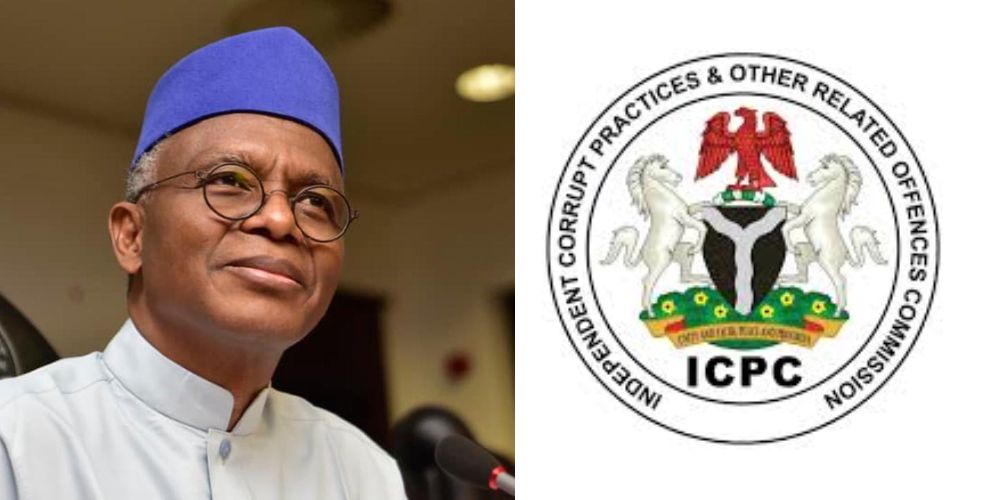
Former Kaduna State governor Nasir El-Rufai has launched a fresh legal offensive against the anti-graft agency, filing a N10 billion suit over what he describes as a calculated effort to cut him off from his loved ones while in custody. The case, lodged at the Federal High Court in Abuja on August 13, centers on claims that officials from the Independent Corrupt Practices and Other Related Offences Commission (ICPC) repeatedly turned away his wife and son during his detention.
Through his counsel, Ubong Akpan, El-Rufai asserts that his wife, Aichatou Asabe, and son, Abba El-Rufai, were barred from seeing him, even when they arrived with food, medication, and other essentials. The former governor has also named the ICPC chairman and the Attorney-General of the Federation as respondents in the suit, arguing that the restrictions violate his fundamental rights under the constitution.
The legal papers paint a troubling picture of what El-Rufai calls an unlawful blockade on family contact. He claims that on July 7, ICPC officers went further, physically restraining and intimidating his wife and son during a visit. That incident, he argues, was a blatant and unjustified interference with his family life, leaving him to endure “humiliation, emotional trauma, anxiety and psychological distress.”
El-Rufai is asking the court to declare that the continued denial of family access without lawful authority is unconstitutional and void. He is also seeking an order compelling the ICPC to grant him “unhindered and reasonable access” to both his family and legal counsel for the entire duration of his detention, as previously directed by the Federal High Court.
The former governor accuses the commission of acting arbitrarily and in a manner inconsistent with Sections 34, 37, and 46 of the Nigerian Constitution, as well as the African Charter on Human and Peoples’ Rights. His Principal Secretary, Mohammed Shaba, filed a supporting affidavit revealing that El-Rufai is being held at the ICPC office in Abuja. Shaba detailed how his wife had been regularly supplying him with food, clothing, medication, and other personal necessities to ensure his comfort and health while in custody.
Shaba also pointed to an earlier ruling by Justice R.M. Aikawa of the Federal High Court in Kaduna, which explicitly directed the ICPC to allow detainees access to their lawyers and personal doctors whenever necessary. That order, Shaba argued, makes it clear that no one in custody should be kept incommunicado, and that the ICPC remains answerable to court supervision over detention conditions.