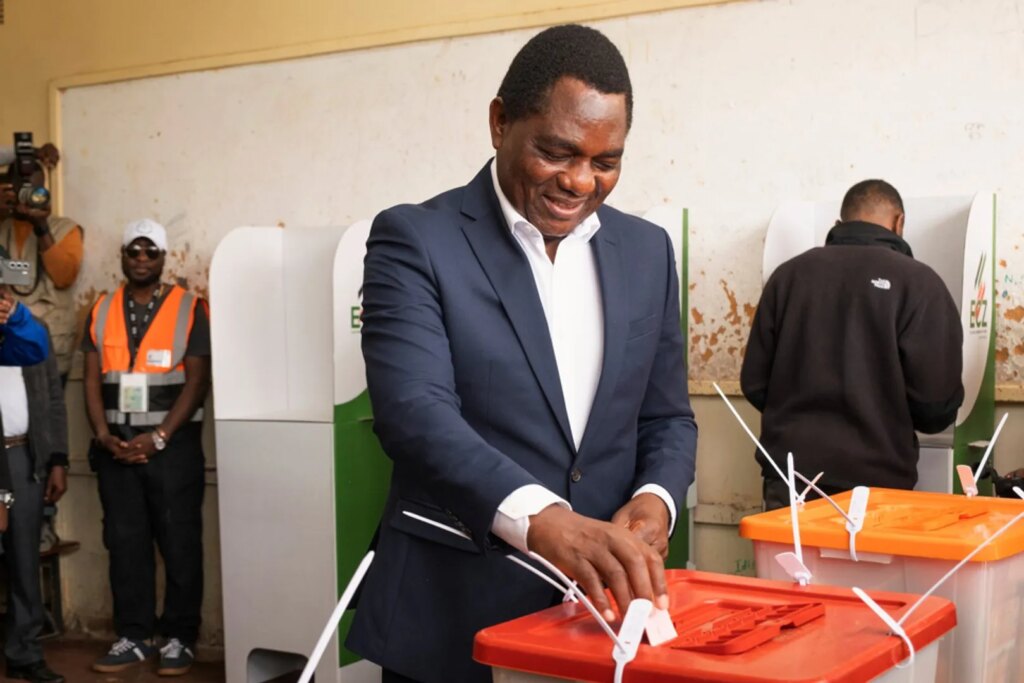
Zambian President Hakainde Hichilema has secured a second term in office, winning re-election with 60 percent of the vote according to official results released after a tense counting period that was briefly suspended following attacks on election officials.
The Electoral Commission of Zambia confirmed the victory for Hichilema and his United Party for National Development (UPND) late Tuesday, cementing a mandate built on pledges to revive the Economy and restructure the nation’s debt. The announcement followed a temporary halt in the tabulation process earlier in the week, triggered by violence targeting electoral staff at several collation centres. Police have launched investigations into the incidents, which raised concerns about the integrity of the process in affected districts, though the commission later resumed counting and declared the outcome credible.
Hichilema, a businessman-turned-politician who first won the presidency in 2021 after five previous attempts, campaigned on a record of securing a $1.3 billion debt restructuring deal with international creditors and restoring investor confidence. His administration has pointed to relative macroeconomic stability and a stronger kwacha as evidence of progress, though critics argue that the benefits have been slow to reach ordinary citizens grappling with high living costs.
The election outcome carries significant weight beyond Zambia’s borders, largely due to the country’s strategic position in the global critical minerals supply chain. Zambia is Africa’s second-largest producer of copper, a metal indispensable for the world’s energy transition, underpinning everything from electric vehicle batteries to renewable energy infrastructure.
Global demand for copper has intensified geopolitical competition for access to Zambian resources. China, a long-standing dominant investor in the Zambian mining sector through firms like China Nonferrous Metal Mining Group, faces increasing rivalry from the United States and its allies. Washington has signalled strong interest in the Lobito Corridor railway project, aimed at linking Zambian and Congolese copper to Atlantic ports, offering an alternative export route that reduces reliance on Chinese-controlled infrastructure.
Analysts suggest Hichilema’s second term will be defined by his ability to navigate this great-power competition while negotiating better terms for Zambian mineral wealth. The government has set an ambitious target to triple copper production to three million tonnes annually within the next decade, a goal requiring massive capital injection and regulatory certainty.
As the new administration takes shape, attention will turn to cabinet appointments and the president’s approach to mining tax policy — a perennial flashpoint between the state and operators. With a decisive electoral mandate secured, Hichilema faces heightened expectations to translate mineral leverage into broad-based economic transformation for a population where poverty remains widespread despite the resource wealth beneath their feet.