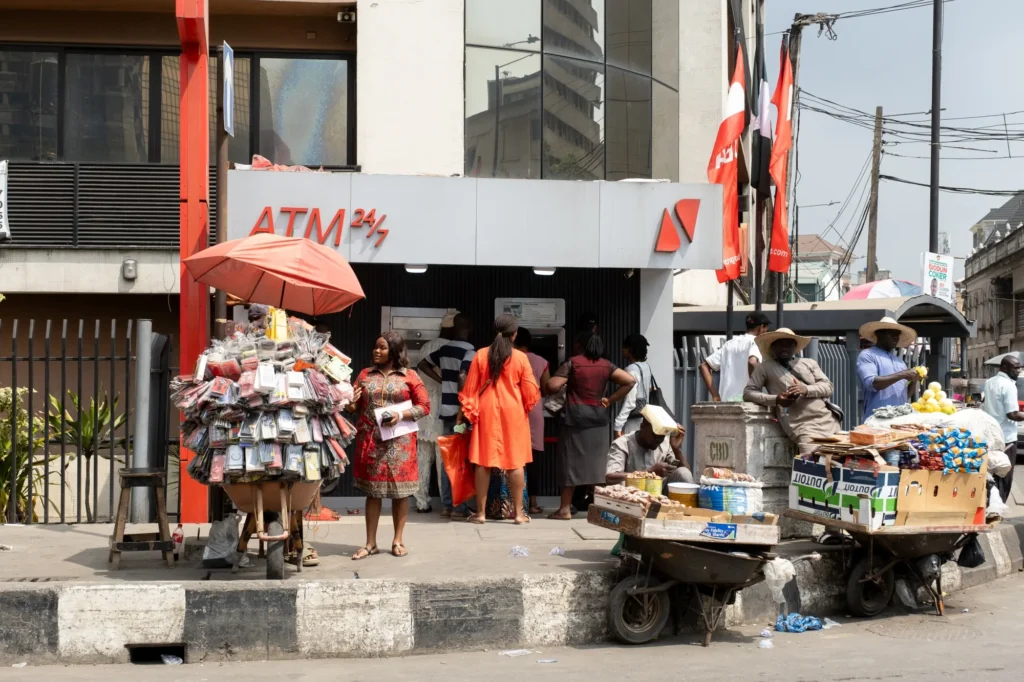
Automated Teller Machines (ATMs) are regaining ground in Nigeria as transaction volumes rise while Point-of-Sale (PoS) agent activity contracts, according to recent data from the Central Bank of Nigeria (CBN). In the first quarter of 2026, Nigerians conducted 438.6 million ATM transactions, a 6.6 percent increase year-on-year. The value of those transactions surged 64.6 percent to ₦26.3 trillion ($19.4 billion). Over the same period, PoS transaction volumes fell 19.9 percent to 2.92 billion, while transaction value declined 16.4 percent to ₦59.3 trillion ($43.7 billion).
The shift marks a reversal for a sector where PoS agents spent years filling gaps left by unreliable ATM infrastructure. Nigeria’s first ATM was installed in 1989 by Société Générale Bank, and the network grew to roughly 22,600 machines by 2021. Years of underinvestment, cash shortages, and technical failures reduced the number of active ATMs to 16,714 by mid-2024. As formal banking channels weakened, Fintech-led PoS networks expanded rapidly. By March 2025, the country had 8.36 million registered PoS terminals, with 5.90 million active. With an estimated population of 237 million, that translated to roughly one terminal for every 28 people, compared with just 13 ATMs per 100,000 adults in 2024, according to the World Bank.
The 2023 cash crisis, triggered by the CBN’s currency redesign and withdrawal limits, cemented the role of PoS agents. When banks and ATMs ran dry, agents became the primary access point for cash, transfers, and basic financial services for millions. At the height of the crisis, the number of deployed terminals reached 2.32 million.
Regulatory changes introduced late last year are now reshaping the competitive landscape. In October 2025, the CBN issued new agent-banking guidelines restricting agents to a single PoS terminal provider and limiting terminal operations to a 70-metre radius. The regulator also capped daily cumulative transactions for PoS agents at ₦1.2 million ($883.9). While these measures do not eliminate the utility of PoS terminals, they constrain the operational flexibility that fueled the network’s rapid expansion.
Simultaneously, the CBN moved to strengthen ATM economics. In February 2025, the bank revised withdrawal fees, capping them at ₦500, and introduced requirements for cash availability and a 24- to 48-hour resolution window for failed transactions. In March, it mandated that card issuers deploy at least one ATM for every 7,500 payment cards issued over the next three years.
The first-quarter figures do not signal an abandonment of PoS agents. Terminals handle a broader range of services beyond cash withdrawals, and their neighbourhood presence offers convenience that fixed ATMs cannot easily replicate. However, the data suggests that one of the biggest advantages PoS agents gained during the 2023 crisis — being the easiest place to obtain cash — is narrowing as banks rebuild their ATM networks under tighter regulatory supervision.