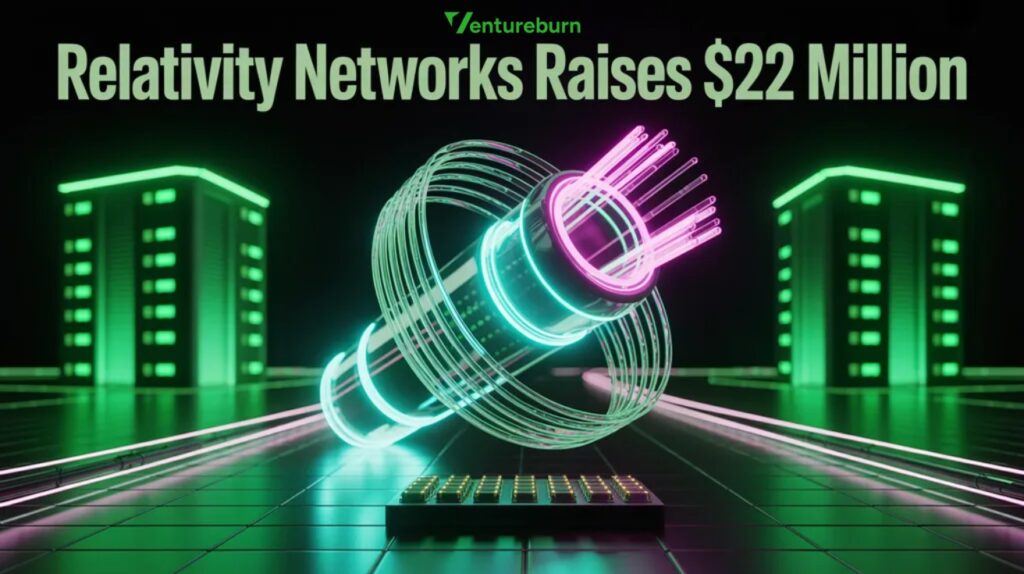
Power grid constraints are forcing artificial intelligence operators to distribute computing clusters across widely separated regions, creating a pressing need for faster long-distance data connections. Relativity Networks has raised $22 million in SAFE note funding to deploy hollow-core fiber technology that promises to reduce latency between data centers by approximately 30 percent.
The financing round, announced this week, was led by Rhapsody Venture Partners with participation from Bell Ventures Inc. and Faster Than Glass LLC. A SAFE note, or Simple Agreement for Future Equity, converts into shares during a company’s first priced equity round and is commonly used by early-stage Startups. Alongside the equity investment, Relativity secured a $40 million follow-on order from a major hyperscale cloud provider that declined to be named.
The funding arrives as the data center industry faces a projected $4 trillion buildout by the end of the decade. Much of that expansion is already limited by electrical grid capacity and regulatory hurdles governing where new facilities can be sited. As a result, developers are increasingly linking multiple existing campuses to function as a single synchronized system.
Conventional fiber optic cables transmit light through glass, which slows the signal. Relativity’s hollow-core fiber guides light through a vacuum chamber at the cable’s center, allowing it to travel closer to its theoretical maximum speed. Chief Executive Jason Eisenholz estimates standard fiber requires roughly five microseconds to move a signal one kilometer. Hollow-core fiber reduces that to about three and a half microseconds.
When artificial intelligence training was confined to a single rack of graphics processors, such differences were negligible. Today’s largest models exceed the capacity of any one building. Data center campuses now sprawl across hundreds of acres and dozens of structures. Because power is scarce, companies are connecting facilities across greater distances while needing them to operate as one cohesive machine.
That synchronization is bounded by physics. Every microsecond of delay between sites creates complications for distributed training and inference workloads. Eisenholz frames the latency reduction as a geographic multiplier: developers can now link sites 30 percent farther apart while maintaining the same synchronization tolerance.
“The first era of AI optimized for compute,” Eisenholz said. “It was GPU, GPU, GPU. The second era optimized the networking inside the data center to take advantage of that compute. The third era that we see coming is optimizing the geography.”
After maximizing chip performance and refining intra-facility networks, the industry must now optimize the space between buildings. The substantial order from a leading hyperscaler indicates commercial demand is already material. As AI models grow and power availability becomes the primary constraint on data center placement, the ability to knit distant sites together with near-light-speed connections could reshape the map of AI infrastructure development. Relativity is attempting to remove one of the last hard limits on how large and how distributed AI computing can become.