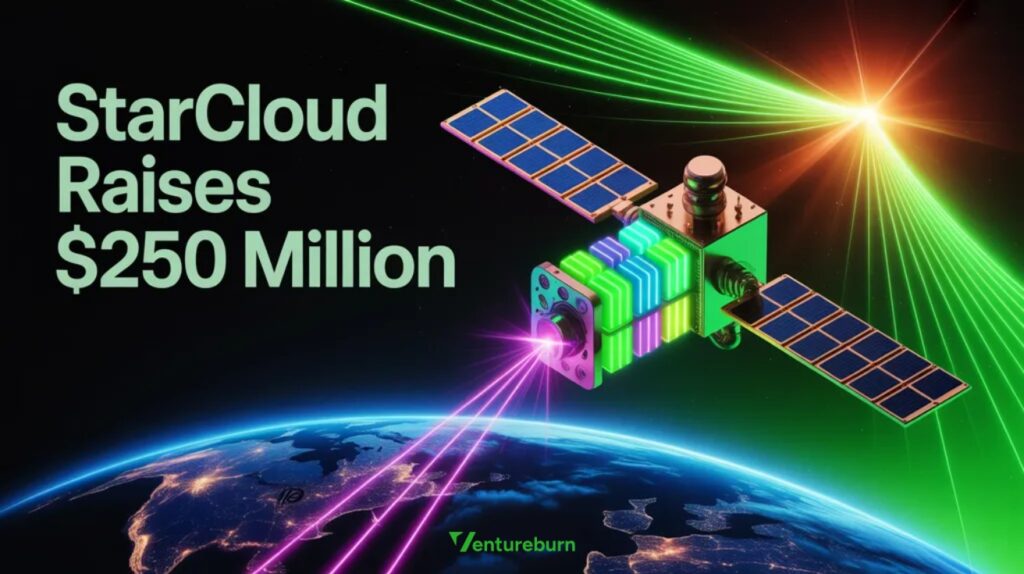
AI hardware startup Starcloud has secured $250 million in fresh funding to advance its plan to move data centers into orbit. The investment round was led by Manhattan West and included participation from Nvidia, Cisco Investments, and more than a dozen other backers. The capital extends the Series A round the company first announced in March.
The funding addresses a growing bottleneck in artificial intelligence development. Training advanced models requires massive amounts of electricity and generates extreme heat. The largest ground-based data centers now consume power equivalent to small cities, relying on grid electricity that is increasingly expensive and constrained. Cooling systems add further cost and complexity. Solar power on Earth is also limited by night cycles and weather.
Starcloud argues that space offers a natural solution. The orbital environment is consistently cold, eliminating the need for energy-intensive cooling. Solar arrays can generate power continuously without interruption. The company also highlights a speed advantage: satellites typically collect raw data and transmit it to Earth for processing, consuming time and bandwidth. By running AI workloads directly in orbit, Starcloud says it can downlink only the processed results.
The company validated the concept roughly ten months ago when it launched a single Nvidia graphics card aboard a small satellite. That test successfully completed an AI training job while circling the planet. Starcloud now plans to scale rapidly through a phased roadmap.
Starcloud-2, the next satellite, will carry AI chips, onboard storage, and a backup module designed for both training and inference tasks. Starcloud-3 will be the first mass-produced version, each unit drawing about 200 kilowatts and equipped with dedicated heat-dissipation hardware built for vacuum conditions. The final vision, Starcloud-4, envisions a cylindrical structure four kilometers across with solar arrays covering 2.5 square miles, housing container-sized liquid-cooled server modules. At full deployment, the constellation aims to reach 88,000 satellites with a combined capacity of 20 gigawatts, rivaling the largest terrestrial facilities without land, water, or grid constraints.
Starcloud is building production lines for the Starcloud-3 satellites and will use the new capital to secure launch capacity. The company’s reported launch partner is SpaceX. Notably, SpaceX is simultaneously developing its own competing orbital AI platform, called AI1. That satellite features a 230-foot wingspan and computing power comparable to Starcloud-3, with mass production targeted for the end of 2027.
The race to orbit reflects a broader shift in how compute infrastructure is conceived. As AI workloads outpace the ability of terrestrial grids to supply power and cooling, space-based data centers are moving from theory to funded development. The coming years will test whether orbital economics, launch reliability, and thermal management in vacuum can deliver on the promise.