

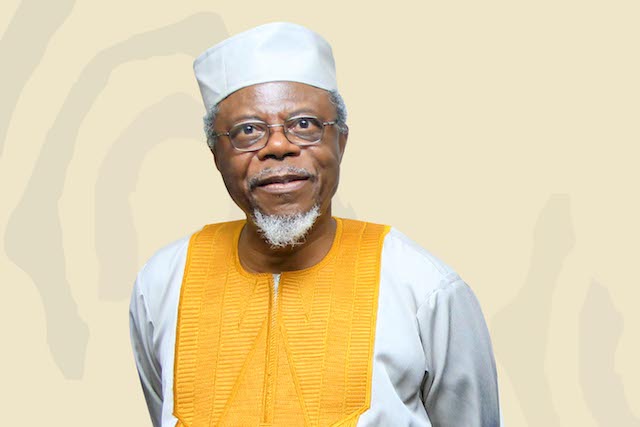
A former Minister of External Affairs, Prof. Bolaji Akinyemi, has called on the Federal Government to reassess its domestic preparedness in light of the ongoing Russia-Ukraine war. Speaking in Lagos on Friday during the second lecture series of the Department of History and International Relations at Lagos State University, Akinyemi addressed the topic, “Competing Narratives on the Russian-Ukraine War.” He warned that some fighters from the conflict are already making their way to Africa, emphasizing the need for Nigeria to be ready to counter any destabilization that may arise from this influx.
Akinyemi stressed the importance of focusing on national security as combatants leave Europe for Africa, which has already contributed to destabilization in the Sahel region. He stated, “Nigeria has to focus on its own security. You’ve got to secure the nation and also increase agricultural production. A hungry nation is an angry nation.” He urged the government to allocate more funds to the security sector, asserting that Nigeria’s troops are capable if they are well-equipped and motivated. He also highlighted the necessity for the incoming leadership to be prepared for significant challenges ahead.
The former minister discussed the binding principle established by the African Union, which prohibits any African country from extending its boundaries into another, contrasting it with Russia’s actions. He remarked, “We have a binding principle adopted way back when the Organisation of African Unity was established. This is the sanctity of the boundaries we inherited at independence.” Akinyemi noted that many Africans oppose Russia’s invasion of Ukraine, while also acknowledging the complexities of the situation in their own regions.
He cautioned against the pitfalls of relying solely on mainstream media narratives when analyzing the conflict between Ukraine and Russia. Akinyemi pointed out that media portrayals often present an edited version of the facts, and he urged scholars and students to seek a deeper understanding rather than accepting surface-level interpretations. “What you get in the media is an edited version of the facts. You also get different interpretations and presentations of the same event,” he explained. He emphasized the importance of historical context in forming conclusions about the war, warning against the fallacy of making judgments without understanding the events leading up to the current situation.
As the general elections approach, Akinyemi challenged Nigerian youths to actively fight for their rights, reminding them that the struggle for democracy requires effort and sacrifice. He shared his personal experiences, stating, “People often think that we got things on a silver platter, but we didn’t. I lost a brother, who was in the army, in the struggle for democracy.” He urged young people to recognize that they must advocate for their interests rather than expect easy victories.
Dr. Adewunmi Falode, the Head of the Department of History and International Relations at LASU, echoed Akinyemi’s sentiments, stating that the lecture aimed to warn Nigerians who may be inciting conflict. He remarked, “The Russian-Ukraine war is a burning topic; it’s ongoing. We are trying to send warnings to Nigerians that in war, you cannot predict the outcome.” Falode highlighted the unpredictability of war, noting that many would not have anticipated the extent of destruction in Ukraine within such a short timeframe. He cautioned against the aspirations of ethnic militias and groups seeking to divide Nigeria, emphasizing the need for unity and caution in these turbulent times.

Comments are closed for this story.