
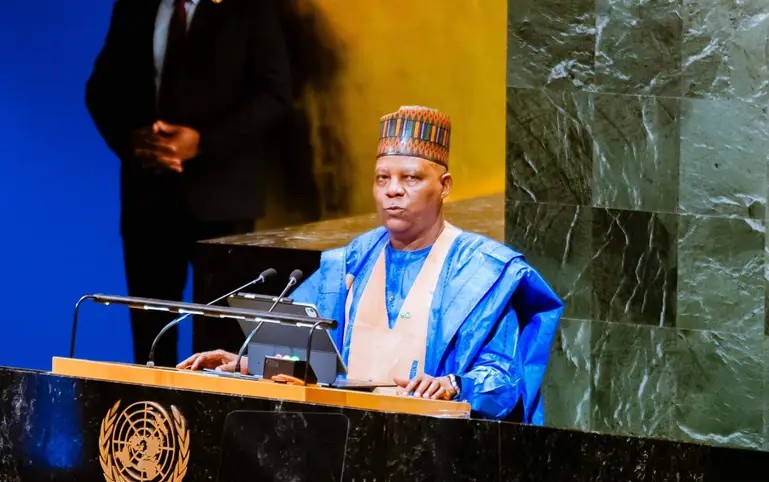
Nigerian President Bola Tinubu urged international financial institutions—including the World Bank, the International Monetary Fund and the African Development Bank—to increase funding for climate action. He made the appeal during the 80th session of the United Nations General Assembly in New York, where Vice‑President Kashim Shettima represented him. Tinubu stressed that the climate crisis demands bold leadership and collective effort, noting that Nigeria aims to mobilise US$20‑25 billion in climate finance by 2030 through green bonds, blended finance and public‑private risk‑sharing mechanisms.
The president called on global partners to provide concessional finance, share knowledge and transfer technology to accelerate Nigeria’s transition to a more sustainable economy. Domestically, Nigeria has undertaken significant reforms to mobilise resources, such as simplifying tax laws, removing fossil‑fuel subsidies and improving revenue efficiency. It has also launched the Nigeria Carbon Market Activation Policy, which creates a framework for high‑integrity emissions reductions and positions the country as a hub for carbon markets.
Tinubu emphasized that no nation can tackle the climate crisis alone; substantial support from international financial institutions and developed countries is essential. He urged developed nations to honour their climate‑finance commitments, including the US$100 billion per year pledged under the Paris Agreement. Nigeria has updated its Nationally Determined Contributions, reflecting greater ambition and integrating mitigation and adaptation measures to protect people, preserve ecosystems and accelerate inclusive growth. The updated targets include a 60 % reduction in the deforestation rate, a mitigation potential of 34.4 MtCO₂eq through reforestation and afforestation, and heightened adoption of cleaner energy systems in manufacturing, industry, public transport and other key sectors.
Further efforts focus on scaling climate‑smart agriculture, building resilient infrastructure and restoring mangroves, forests and wetlands to enhance carbon sinks. Institutionally, Nigeria has established the National Council on Climate Change to ensure coherence, accountability and measurable results. Tinubu reaffirmed that climate action is not a trade‑off between growth and sustainability; rather, it is a pathway to sustainable growth, innovation, security and shared prosperity. Nigeria stands ready to work with all partners to lead and deliver on climate action, recognizing that the time for action is now.


Comments are closed for this story.