
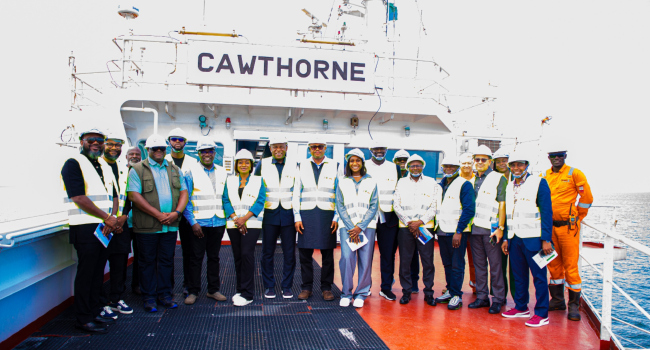
Nigeria has commissioned its first wholly owned Floating Storage and Offloading (FSO) vessel, the Cawthorne, which can hold 2.2 million barrels of crude. The double‑hull vessel is a joint project of NNPC Limited, Sahara Group, Eroton E&P, and Bilton Energy Ltd., and it marks the country’s first new crude‑oil terminal in 50 years. Stationed offshore Bonny, the Cawthorne will receive, store, and offload crude to export tankers, providing a reliable solution to the logistical and infrastructural constraints that have limited Nigeria’s crude‑evacuation capacity.
Equipped with digital capabilities such as a Marine Control System and artificial‑intelligence‑driven automation, the vessel ensures safe and secure operations while maximizing efficiency in import and export processes. According to Udobong Ntia, EVP Upstream at NNPC Limited, the commissioning of the Cawthorne FSO is a bold achievement that will guarantee seamless operations and support President Asiwaju Bola Ahmed Tinubu’s strategic targets for optimized upstream production in Nigeria. Seyi Omotola, NNPC Chief Upstream Investment Officer, called the vessel a “renewed hope” for the upstream sector, noting that it reaffirms the nation’s growing capacity to make its energy sector globally competitive. The Nigeria Upstream Petroleum Regulatory Commission (NUPRC) also praised the project, saying it aligns with its vision of accelerating production reliably, seamlessly, and sustainably.
The Cawthorne FSO is expected to improve Nigeria’s export reliability and contribute to a more stable global energy supply chain. It was conceived to address persistent challenges in the country’s evacuation system, including limited barging capacity, delays in ship‑to‑ship transfers, and reduced vessel accessibility caused by siltation at various berthing slots. Converting the vessel from a Very Large Crude Carrier (VLCC) into a fully integrated FSO required extensive engineering work, state‑of‑the‑art mooring systems, and cutting‑edge import and export infrastructure.
The commissioning of the Cawthorne reaffirms the partners’ commitment to powering progress responsibly through partnership, innovation, and infrastructure that strengthens Africa’s energy independence. The vessel is expected to reduce pipeline dependency and the risks of oil theft and vandalism while providing a safe environment for crew and operations staff. With a scalable platform capable of accommodating future production increases and tie‑ins from surrounding oil fields, the Cawthorne FSO is set to play a strategic role in Nigeria’s energy sector.


Comments are closed for this story.