
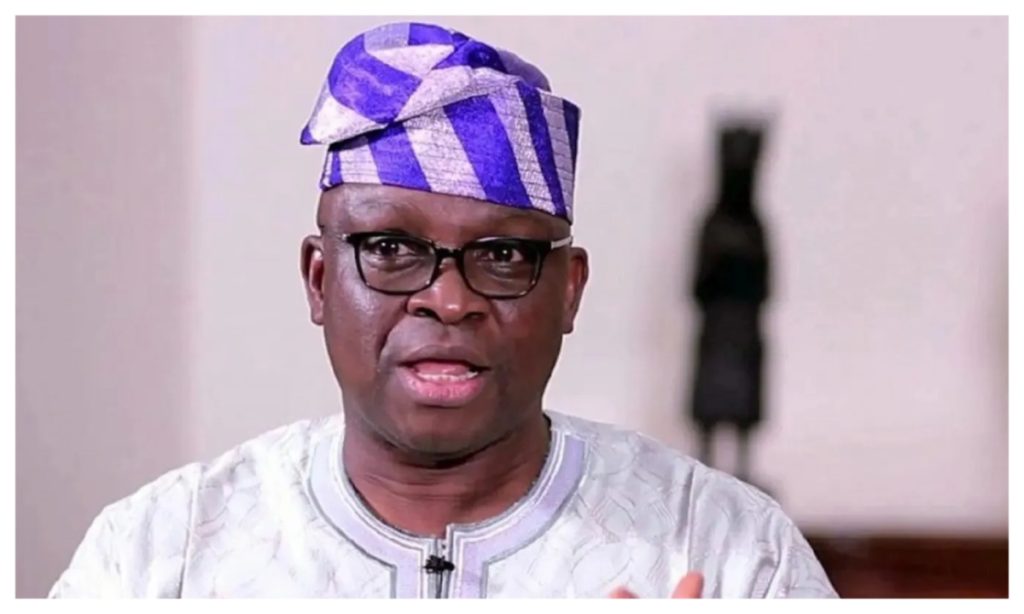
A protest was held at the United States Embassy in Abuja by members of the Peoples Democratic Party (PDP), prompting a reaction from former Ekiti State Governor Ayodele Fayose. Fayose described the demonstration as “a shameful last kick of a dead National Working Committee, NWC of tax collectors.” He suggested that, instead of protesting in Abuja, the suspended National Chairman, Umar Iliya Damagum, and his associates should have taken their grievances to the White House in Washington.
Fayose questioned why the United States and other European countries were being drawn into the internal affairs of a Nigerian political party. He wondered whether external parties were to blame for the PDP leadership’s failure to adhere to its own constitution. A recent court ruling had instructed the PDP to complete outstanding state congresses before holding a national convention. According to Fayose, rather than addressing these requirements, the party’s leadership chose to suspend key members of the NWC, including the National Secretary, who is responsible for issuing meeting notices.
Prior to this, the PDP had become embroiled in a legal dispute over representation, even though the constitution clearly states that the National Legal Adviser has the authority to represent the party in court. Fayose argued that the consequences of the party’s actions are its own responsibility and not a concern for the United States or any other external entity.
The protest at the US Embassy has highlighted the ongoing internal conflicts within the PDP, which has been plagued by power struggles and infighting. The party’s ability to resolve these internal issues will be crucial in determining its future prospects in Nigerian politics. As the situation continues to unfold, it remains to be seen how the PDP will address its challenges and move forward.

Comments are closed for this story.