
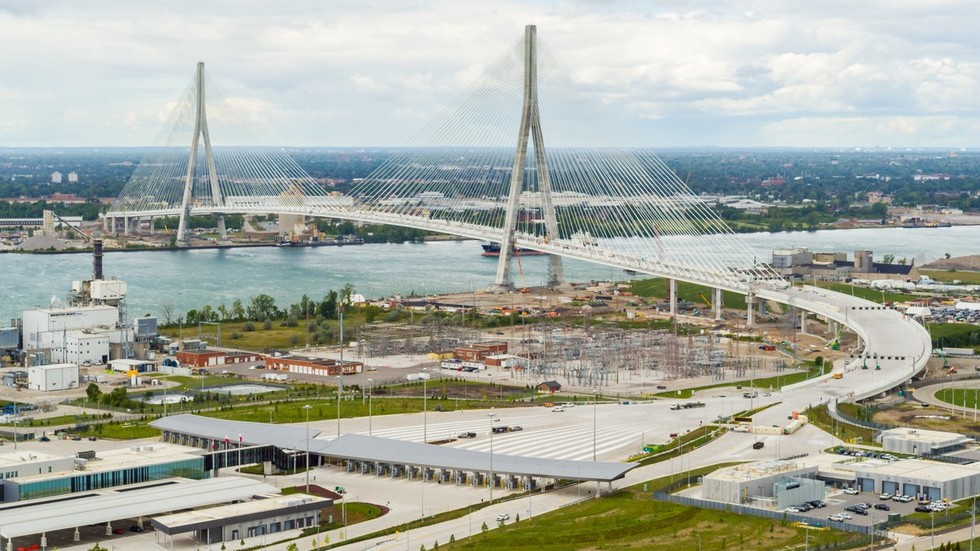
US President Donald Trump has stated he will not permit the Gordie Howe International Bridge to open unless the United States receives full compensation and at least half ownership of the project. His remarks, posted on Truth Social, intensify existing trade tensions between the US and Canada.
The Gordie Howe International Bridge, a six-lane crossing between Windsor, Ontario, and Detroit, Michigan, is nearing completion after construction began in 2018. Expected to open early this year following final testing, it is designed to reduce congestion on the existing Ambassador Bridge and facilitate substantial bilateral trade. Project costs have risen to $6.4 billion from an initial $5.7 billion estimate. The Canadian government confirms the bridge is fully funded by Ottawa and will be publicly owned by Canada and the state of Michigan.
In his social media post, Trump argued that US market revenue justifies a significant ownership stake, claiming Canada benefits disproportionately. He alleged the bridge was built with “virtually no US content,” referencing a waiver under former President Barack Obama that allowed Canada to bypass Buy American requirements. Trump also revisited longstanding issues, including Canadian dairy tariffs, provincial restrictions on US alcohol sales, and Canada’s outreach to China.
Canadian officials have rejected these assertions. Windsor Mayor Drew Dilkens described elements of Trump’s post as “insane,” noting that US steel was used on the Michigan side of construction. Prime Minister Mark Carney has denied that Canada is pursuing a free-trade deal with China and urged Washington to respect Canadian sovereignty.
This threat emerges amid broader strains in US-Canada relations. Trump has previously warned of steep tariffs on Canadian-made aircraft and suggested punitive measures if Ottawa deepens trade ties with Beijing. While Trump endorsed the bridge during his first term, calling it a “vital economic link,” the project has long faced opposition from owners of the Ambassador Bridge.
The Gordie Howe International Bridge is projected to become one of the busiest trade corridors between the two nations, handling billions in annual commerce. The dispute highlights the sensitivity of cross-border infrastructure and the potential for political rhetoric to delay critical projects. Resolving this issue will require diplomatic engagement to align with the binational ownership agreement and ensure the bridge’s timely operation, which is vital for economic stability in the region.


Comments are closed for this story.