
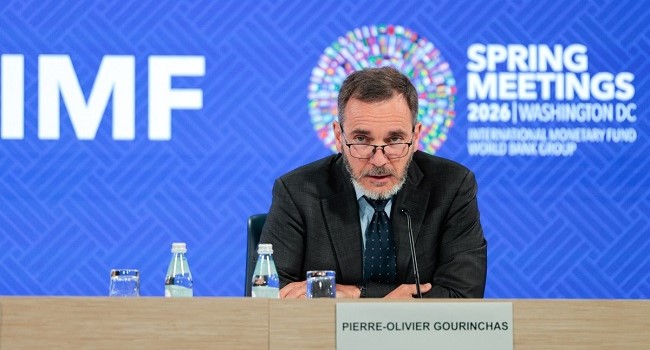
The International Monetary Fund (IMF) has revised Nigeria’s economic growth projection for 2026, lowering it to 4.1 percent. This adjustment is attributed to the ongoing fallout from the conflict in the Middle East, which has led to increased energy and commodity prices throughout the region. The announcement was made during the IMF and World Bank Spring Meetings held in Washington, D.C. Officials emphasized that supply shocks related to the war are hindering recovery in economies that rely on energy imports.
IMF Chief Economist Pierre-Olivier Gourinchas explained that the downgrade reflects the growing pressures faced by countries dependent on imported fuel, with Nigeria being particularly susceptible to rising shipping and fertilizer costs. He noted, “Across Sub-Saharan Africa, we are seeing some downgrade of growth and an uptick in inflation in a number of countries.” Gourinchas highlighted that the impact aligns with broader trends, especially for energy-importing nations.
Denz Igan, head of the IMF’s World Economic Studies Division, added that while higher oil prices may provide some relief, the overall effect is a projected decline in growth for 2026. He stated, “War-related higher fuel and fertilizer prices and increased shipping costs are going to weigh on non-oil activity in Nigeria.” Although there is some offset from rising oil prices, Igan indicated that the net result is weaker growth this year, with a potential recovery anticipated in 2027.
The IMF also forecasts that median inflation in Sub-Saharan Africa will increase from 3.4 percent in 2025 to 5 percent in 2026. This rise is driven by high oil and fertilizer prices, possible fuel shortages, and escalating logistics costs. For Nigeria, officials emphasized the importance of maintaining a tight monetary policy to achieve the central bank’s inflation targets. Furthermore, the IMF warned that bilateral aid to Sub-Saharan Africa has decreased by 16 to 20 percent in 2025, diminishing a crucial buffer as commodity and shipping costs continue to surge. In response to these challenges, officials noted that the Fund is collaborating with the International Energy Agency and the World Bank to monitor disruptions in energy markets and evaluate the needs of individual countries in the current climate.



Comments are closed for this story.