
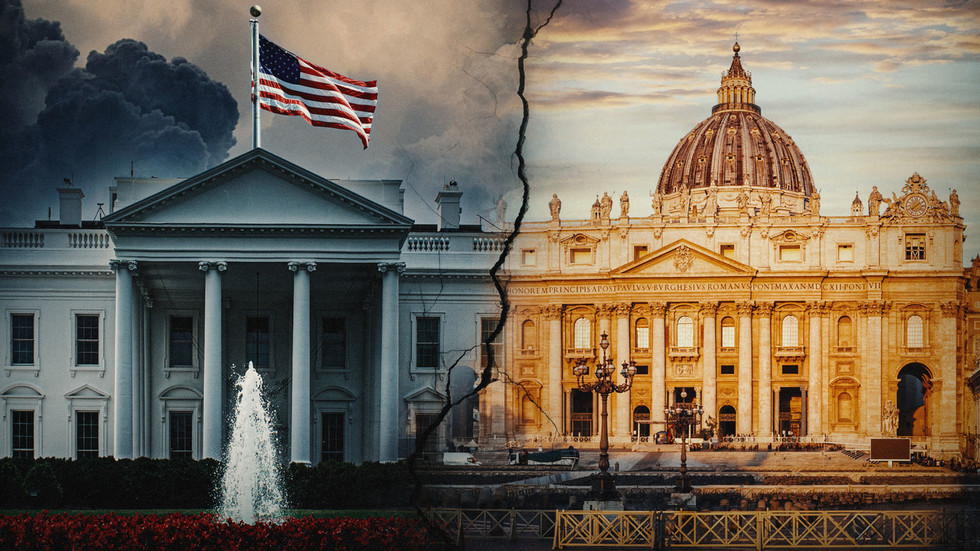
US President Donald Trump has recently launched a public attack on Pope Leo XIV, marking one of the most personal and heated confrontations between a sitting American president and the Vatican in recent history. The dispute began after the pontiff criticized the US-Israeli military campaign in Iran, labeling Trump’s threat to destroy Iranian civilization as “truly unacceptable.” He further asserted that God “does not listen to the prayers of those who wage war.” In response, Trump, who identifies as a non-denominational Protestant, used unusually personal language, describing the Pope as “WEAK on Crime, and terrible for Foreign Policy.” He claimed that the Catholic Church had deliberately chosen Leo to “deal” with him, adding, “I don’t think he’s doing a very good job,” and expressed his desire for a Pope who does not criticize the President of the United States.
The feud intensified when Trump shared an AI-generated image of himself depicted as a Jesus-like figure, robed in white and surrounded by fighter jets and US flags. This post drew accusations of blasphemy, with some conservative allies, including former Republican congresswoman Marjorie Taylor Greene, condemning it as embodying “an Antichrist spirit.” Italian Prime Minister Giorgia Meloni, typically a close ally of Trump, called the attack on the Pope “unacceptable.” Meanwhile, the US Conference of Catholic Bishops expressed their disappointment, stating they were “disheartened” by the president’s “disparaging words about the Holy Father.” This controversy has also reignited attention on Trump’s decision not to place his hand on a Bible during his second-term inauguration, a departure from the longstanding tradition observed by US leaders, including Trump himself in 2017.
While this clash is particularly personal, tensions between US presidents and the Vatican have a long history. During the 2016 campaign, Pope Francis questioned Trump’s Christian faith due to his pledge to build a wall on the US-Mexico border, prompting Trump to label the remarks as “disgraceful.” This dispute continued into Trump’s first term, with Francis criticizing the administration’s mass deportation policies. Under President Obama, relations were strained over issues of abortion and religious freedom, with the Holy See reportedly rejecting his nominees for ambassador as “insufficiently pro-life.” In 2011, the US terminated a multi-million-dollar contract with US bishops over contraception referrals, further souring ties.
In 2013, revelations that the NSA had monitored communications between cardinals and bishops during the election of Pope Francis sparked outrage, with many Catholics viewing it as an attack on the Church. One of the most serious confrontations occurred under President George W. Bush, when Pope John Paul II openly opposed the 2003 invasion of Iraq, calling it “a defeat for humanity.” The Pope sent a personal letter to Bush urging him not to invade, but the president reportedly set it aside, insisting it was “God’s will” to go to war. When Bush visited the Vatican in 2004, John Paul reiterated his opposition, leading Bush to leave without the customary gift exchange photo.
Under President Clinton, clashes centered on abortion and contraception, with the Pope publicly rebuking Clinton during a 1993 meeting in Denver and again at the 1994 UN population conference in Cairo. Even Clinton’s 1999 welcome for the Pope in St. Louis was overshadowed by the pontiff’s defense of the unborn and calls for a “culture of life.” With over 60 million adherents in the United States—roughly 20% of the adult population—the Roman Catholic Church remains America’s largest single religious denomination. Pope Leo XIV, the first US-born pontiff, is viewed favorably by 84% of American Catholics, underscoring the potential political and social impact of the current dispute.

Comments are closed for this story.