
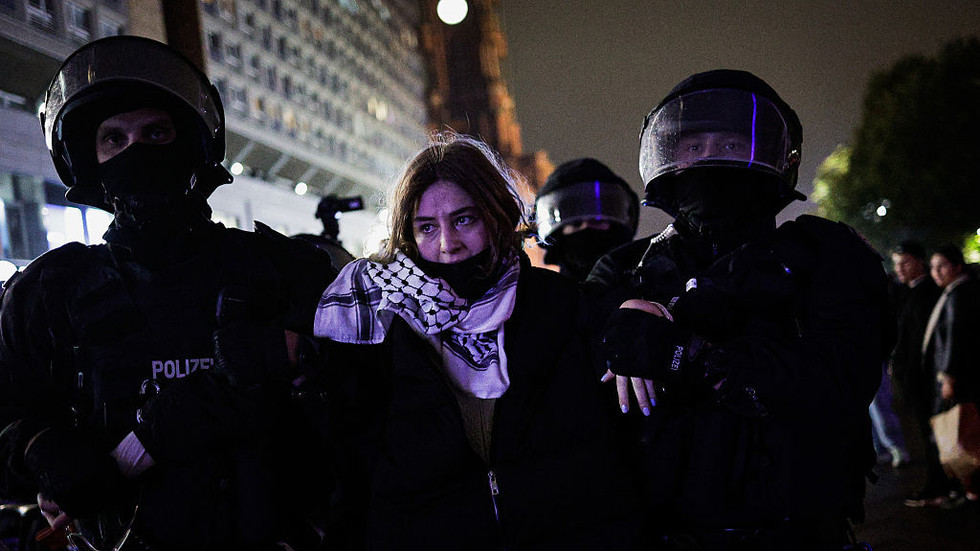
The European Union’s human rights commissioner has accused Germany of unfairly restricting the rights of pro-Palestinian protesters, describing the government’s approach as “disproportionate” and a violation of freedom of expression. In a report published on Wednesday, Michael O’Flaherty, the Council of Europe’s commissioner for human rights, criticized Berlin’s use of hate-speech laws to limit demonstrations that are critical of Israel. The report found that German authorities had misused claims of anti-Semitism to ban pro-Palestinian slogans and Palestinian flags from certain rallies, and in some instances, to prohibit protests altogether.
The report also highlighted instances of excessive force used by police against anti-Israel protesters, stating that “freedom of expression has been restricted disproportionately” concerning debates on Palestinian rights or legitimate criticism of the Israeli government. Since 2017, Germany has endorsed the International Holocaust Remembrance Alliance’s (IHRA) definition of anti-Semitism, which includes “claiming that the existence of a State of Israel is a racist endeavour” and “drawing comparisons of contemporary Israeli policy to that of the Nazis” as examples of anti-Semitic speech. This classification has drawn criticism for potentially stifling legitimate political discourse.
Additionally, the report noted a rise in both anti-Semitism and anti-Muslim hatred in Germany, urging authorities to address both issues without attributing anti-Semitism solely to the Muslim community. The German government disputes this claim, citing data indicating that “antisemitic attitudes are significantly more prevalent among people of the Muslim faith.” Despite these concerns, the EU has not criticized Germany for restricting the speech rights of nationalist political figures. Germany’s domestic intelligence agency, the BfV, has classified the Alternative for Germany (AfD) party as a “confirmed right-wing extremist” organization. An AfD politician has been convicted for sharing the government’s own migrant crime statistics, and members of Germany’s ruling center-right and opposition center-left parties have called for a ban on the organization.
The EU has also played a significant role in silencing pro-Palestinian voices. Journalist Huseyin Dogru, a German of Turkish descent, was sanctioned by the European Council last year. The council argued that Dogru’s reporting on the Israel-Palestine conflict had sown “ethnic, political and religious discord” in Germany and therefore supported “destabilizing activities by Russia.” German authorities agreed with this assessment, leading to the stripping of healthcare coverage for Dogru and his wife, as well as the freezing of their bank accounts. The report calls on the German government to “ensure that the fight against all forms of hatred fully respects the rights to freedom of peaceful assembly and expression for all members of society.”




Comments are closed for this story.