
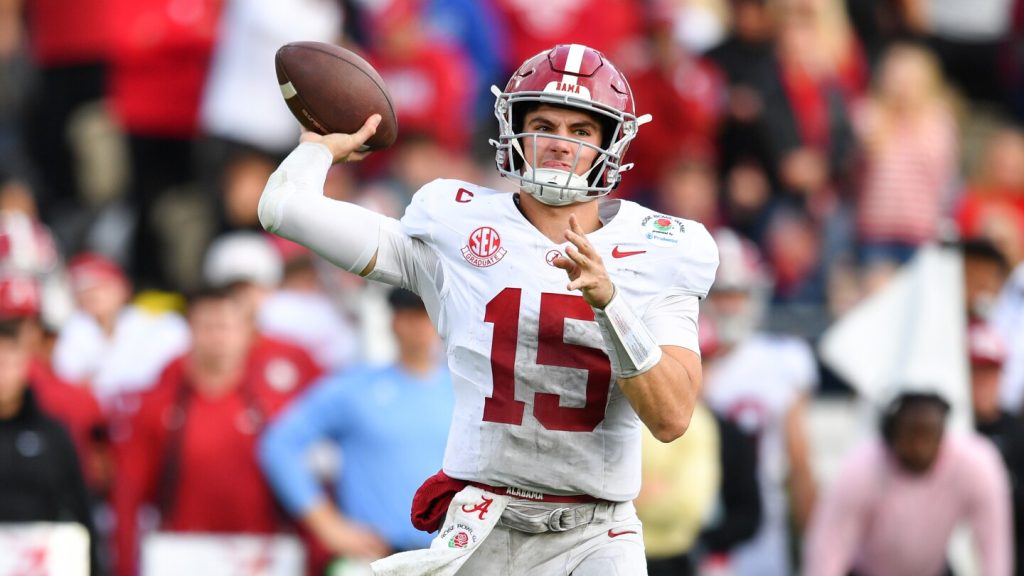
Former Alabama quarterback Ty Simpson is poised to be selected in the late first round of the NFL Draft on Thursday night, which would secure him a guaranteed four‑year contract worth roughly $20 million. Despite this opportunity, Simpson revealed he seriously considered turning it down in favor of a lucrative college offer. On David Pollack’s podcast, he disclosed that Miami had previously extended a $6.5 million NIL deal for him to transfer and play for the Hurricanes in 2026. “The last offer was definitely one that I just had to sit down and consider, because it would have been life‑changing money,” Simpson said. “It would have made me the highest‑paid player in college, and it was something where I was like, I can’t just ignore this. I have to sit down and think about it.”
Simpson, who served as a backup at Alabama for three years before becoming the starter last season, sought guidance from his former coach, Nick Saban. “I actually talked to Coach Saban about this,” he recounted. “He asked, ‘Do you want to play football in college, or do you want to play football professionally? Take the money out of it, take the rounds out of it—what do you want to do next year?’ Without hesitation, I said, ‘I want to play professional football.’ And he was like, ‘Well, there’s your answer.’ It’s something I’ve always dreamed of, and I felt I was ready to take that next step, be the face of a franchise and lead a locker room.”
Simpson’s dilemma highlights a shifting dynamic in American football, where Name, Image, and Likeness (NIL) deals enable college players to earn substantial sums that can rival or exceed early NFL contracts. This new financial landscape forces athletes to weigh the benefits of another year in college against the potential of entering the professional ranks. The rise of NIL compensation has transformed both college and professional football, altering how players approach their careers and how programs recruit and retain talent. As Simpson prepares for his NFL future, his experience underscores the complex decisions facing top college athletes in an era where financial incentives extend beyond the professional league.
Comments are closed for this story.