
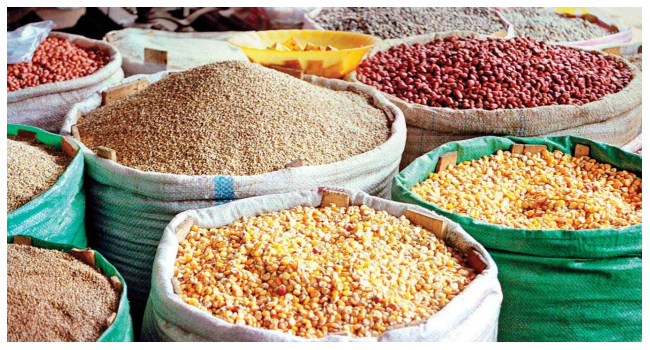
Consumers faced higher food costs in March 2026 as prices for eggs, beans, rice, garri and other staples rose, according to the National Bureau of Statistics’ Selected Food Price Watch for the month.
The report, released on Wednesday, showed mixed movements in key items. The average price of a crate of 30 eggs fell 20.12 % year‑on‑year to ₦6,127.62, but rose 2.00 % from February 2026. Brown beans (1 kg) declined sharply, recording a 49.32 % drop from ₦2,616.26 a year earlier to ₦1,325.85, although the month‑on‑month price was up 1.41 % from February’s ₦1,307.44.
White garri sold loose (1 kg) fell 41.19 % compared with March 2025, reaching ₦801.54, yet was 1.38 % higher than in February. Onion bulbs (1 kg) decreased 19.63 % year‑on‑year to ₦1,153.14, while showing a 1.59 % rise from the previous month. Fresh ginger (1 kg) rose 20.46 % year‑on‑year to ₦5,541.25 and increased 0.61 % month‑on‑month.
State‑level data revealed considerable regional differences. Taraba State posted the highest average egg price at ₦6,999.00 per crate, whereas Niger State recorded the lowest at ₦5,610.04. For brown beans, Oyo State was the costliest at ₦1,937.20 per kilogram, while Taraba State offered the cheapest at ₦745. White garri prices ranged from a high of ₦1,075.45 in Abia State to a low of ₦513.78 in Plateau State. Onion bulbs were most expensive in Abia State (₦2,115.67 per kilogram) and cheapest in Kwara State (₦829.91).
A zonal analysis showed similar divergence. The South‑East zone led egg prices at ₦6,521.47 per crate, followed by the North‑East (₦6,375.91); the North‑West recorded the lowest at ₦5,908.61. Brown beans were most expensive in the South‑West (₦1,770.57) and South‑South (₦1,762.49) zones, with the North‑West again at the bottom (₦851.11). White garri peaked in the South‑South (₦942.68) and South‑East (₦942.04), while the North‑Central zone offered the lowest price (₦670.16). Onion bulbs commanded the highest price in the South‑East (₦1,714.81) and the lowest in the North‑Central (₦907.76).
The March 2026 price trends underline persistent volatility in Nigeria’s food market, reflecting both seasonal factors and broader economic pressures. Continued monitoring by the National Bureau of Statistics will be essential for policymakers and consumers seeking to navigate these fluctuations.




Comments are closed for this story.